A few Abstract Heads

Here are a few of my old Abstract Heads. Emma suggested that I put up some work to review, reflect and rejoice in.


From right to left, the last AH I painted, "Paula". I never really realised that the eyes were so far down, nor that her mouth was so wonky, but she was doing an exam at the time. I think the colours reflect her quite well, but I´m not too happy with the blue on the top right of the top painting. It´s a bit glossy compared to the very flat nature of the other colours.

Next up is is "Caroline (Playing the Guitar)" from 2008. A much narrower range of colour, using just blue and yellow, with the green stripe representing her hair falling across her face.

As an experiment I tried to create some AHs of famous artists, including Picasso and Hirst. The idea was to use photos of them at different ages to create the triptych. Only this one worked. Can you figure out who it is?

Finally, "David", who is a photographer, and whose pictures of Barcelona are fabulous, is another experiment, this time trying to add the feel of his work into the lines I abstracted from his face as I sketched him. I wasn´t completely happy with the result, and, as I was in my tissue paper phase, decided to add a few pieces to some areas.

On Jose Pedro Croft

Jose Pedro Croft
Vv.Aa.,
Publisher: Xunta De Galicia
ISBN: 8445335618 Edition: Paperback; 2004-01-02


"The sculptor suggests viewers engage in exercises of approach and escape."

"The hand as the extension of the eye, the eye as a prelude to touch."

"painting bronze (white) to relieve the sense of weight."

"He replaces volumes with their defining lines, he knocks down planes to create delicately balanced figures, extremely slight shapes the eye is continually approaching yet does never actually rest upon them."

"An object between painting and sculpture. It is not replacing anything; it does not want to represent anything beyond what it actually is: presence and witness of the world at the same time." [On "Sin titulo 2002, carton y espejo 35x21cm (Prada shoebox lid)]

"...totalising sculpture, where everything matters, makes a difference, makes sense."

"The important thing is to perceive the spaces between lines, between colour fields, exploring the representation of depth and movement. However, the artist despises the mathematic precision in favour of a more organic evolution of shapes and planes, incorporating work accidents: draining colours, stains, inkblots, fingerprints etc. The results of these procedures tend to adhere to the scaffolding where the drawing began, installing an increasing disorder by bringing about a stimulating energy to one of the founding structures of modernism."


Croft Jose Pedro - Cadernos De Viagem
Jose Pedro Croft,
Publisher: Xunta de Galicia
ISBN: 8445335316 Edition: Hardcover; 2003-07-31


"Drawings by sculptors are different, there is something about them which gives them a distinctive air, something that is difficult to pinpoint."

"Suffice it to vary by a millimetre."

"...he lingers before hollows, before the appearance of the three-dimensional as an emotion rather than as a certainty."

Finishing Work

Why is my only finished piece called "Alex (Unfinished)?

As my friend Ralph Bernabei said "People keep coming into my studio and saying "Oh, I like that.. how much is it?" and I look at it and I wonder to myself, if it is even finished yet. Still, if they want to buy it...."

Is it true that my work has a feel of experimentation, play, trying things out, using different materials but nothing really feeling finished? With work such as "Abstract Heads" it was easy to decide when a work was finished... the whole canvas was covered with paint. Though sometimes I would sit back and look at it and change one section to another colour. But one day as I was sitting at the dining table I looked at one work that I had not yet completed. And as I looked at it, I realised that it was, in fact, finished.


What does a "finished piece" mean? When do you know when a piece is "finished"?

Graffiti Slabs

Tutorial Monday 21 Feb 2011

MA Tutorial report form
Date; Monday 21 Feb 2011
Name; Jonathan Holden

________________________________________________________________

Reflection on outcomes since last tutorial

None

________________________________________________________________

Current projected aims and outcomes

Get to understand what my tutors expect of me from this course.
Get to grips with the requirements of this course.
Complete assignments as required.
Develop relationships with fellow students.
Continue reflections on first tutorial, and develop artistic ideas through reading, discussing with colleagues and working through issues to attempt to resolve problems.

________________________________________________________________

Discussion and recommendations
Reflect on each series - values - did it work or not? Look at work as if in a gallery.
Work looks rushed/ impatient keep experimenting, but finish work FINISHING WORK What am I really about? find depth, commitment to method / idea / subject / value / judgement
E.g. Gender [why are all my Abstract Heads female? What about the “Seven ages of man”?? but no, gender is not something i am interested in... I read that females sell... I found the male mannequins (but have since given them away after selling two)]
Reflecting of myself > but what of myself?? Look at the work of Nancy Spero, Jonathan Lasker and Beatrix Milhazes to develop this idea.
How far can I push my work? What´s the next work after this? Which reflect me and what I want to say?
Sensitivity to materials - appropriateness / Capvespres are chunky Seven ages of man too literal.
BE METAPHORICAL a novelist might talk about the mundane (going to the corner shop) but I want to read it. It doesn´t have to be a great idea... take an idea to its boundaries... for example in the work of Helen Chadwick and Cornelia Parker
Painting into 3D - take a look at: Robert Rauschenberg Jasper Johns Julian Opie Patrick Caulfield
Abstract Heads Series - Interesting use of colour - seems thought about, distinct sense of personality. Think about how I am making decisions about colour - making / placing / playing
e.g. Ellsworth Kelly. Peter Halley - geometric abstraction/ architectural forms

Herbert Read "History of Sculpture" p.56 - Google Docs

Most of the exotic influences I have described are ‘primitive’ in the sense defined by Van Gogh - they proceed from works that are the expression of feeling and instinct - simple, serene, devoid of all intellectual sophistry. Other exotic influences on the development of modern art have been more complex, simply because they come from a phase of a past civilization that is itself more complex. There is, after all, a difference of both style and quality between African Negro sculpture
and Egyptian sculpture
, a still greater difference between Negro sculpture and Greek sculpture of the geometric period.
Etruscan sculpture also belongs to a relatively sophisticated civilization
and Mexican sculpture of the kind that affects our sensibility may belong to the decadence of that highly complex civilization.

Very few modern artists have sought in exotic art a simplicity ‘as beautiful as the Work of Millet’. Rather they have been attracted by its remoteness and its mystery, even its complexity. This is certainly true of Far Eastern art, the extremely refined expression of a metaphysical outlook that has nothing in common with the art of Africa or Tahiti. We know Very little of the religion and philosophy of the Incas Mayas, but again it was complex rather than simple, fearful rather than serene. Even when we do come to the primitive art of our own Christian civilisation, to Romanesque
or Gothic art
(both fundamental influences on Picasso and Henry Moore), we are in the presence of spiritual qualities that have quite a different metaphysical significance. But two qualities perhaps all these exotic arts have in common - their remoteness in time and the symbolic nature of their representations. Modern man has been in search of a new language of form to satisfy new longings and aspirations - longings for mental appeasement, aspirations to to unity, harmony, serenity - an end to his alienation from nature. All these arts of remote times or strange cultures either give or suggest to the modern artist forms which he can adapt to his needs - the elements of a new iconography.

Read, H 1964 “ A Concise History of Modern Sculpture” p.56

TƔpies Library

My new library... where I'll be studying for my Masters in Fine Art!

Library

Art Display - Jonathan Holden

Here's an Art display I made from bricks, rebar and plastic sheet, all found on the streets of Gracia!

How to work with concrete

Here's some tips and links:

Lifewater A page about concrete from a Well-making charity.

Art Concrete Tips on how to use concrete for art.

Technical Concrete Information

Here's some artists:

David French Some cast sculptures.

Carved Concrete With ash from Mount St. Helens!

Hannes Kuehtreiber Small scale concrete block art.

Joaquin AviƱa Concrete furniture.

Carol Boram-Hays Abstract sculpture.

Deborah Brackenbury Concrete Bowls

Curt Pieper Concrete Furniture

Working with concrete

Well... here it is at last... I have started working with concrete... and discovered that I'm going to need to hunt for a lot more moulds! I started by filling a mould with water in order to give me the right amount of concrete, but even with pouring most of it on the floor (see pics!) I still made much more concrete than I needed for that one mould. I'm also cheating with three moulds but sticking extra bits on polystyrene over "holes" in the mould. I'm just hoping that the concrete comes out easily, and I can re-use the moulds.

Five first works

Here are five of my favourite current works:

Carte JD Holden 2010
C
Darts JD Holden 2010

Earth JD Holden 2010

Farty JD Holden 2010

Garth JD Holden 2010

Comments on "WIP - The City"

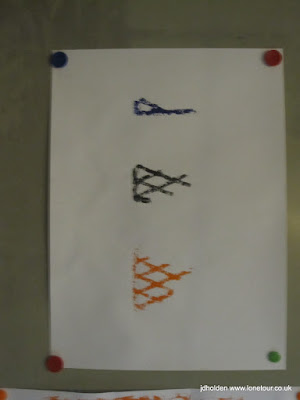
My first series of "Works on Paper - The City" are coming on rather well, though I do say so myself. It should be apparent that some of these are pretty raw, rough ideas, and that others are fairly close to what the final pieces will look like. I've enjoyed the discipline of working with limitations - limited colours, shapes, embossings; but also limited titles too. Some of the titles have given me more of a problem than others, and I am trying to do two or three ideas for each title, in order to give myself more opportunity to create a coherent whole, to feel that the language of the work is coming together. I'm trying to follow the advice Michael Young gave to Julie Mehretu "to make drawings, hundreds of drawings. To get lost in the process." I am hoping this will lead me, as it has for Mehretu, "to use her new vocabulary of marks...[to create] an internal world made in a language of her own invention" (The New Yorker Mar29,2010).

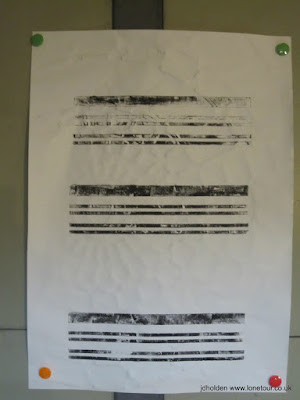
This is one of my first attempts at printing. I realised that there was a real sense of movement here, potentially falling off the page.
From first ideas

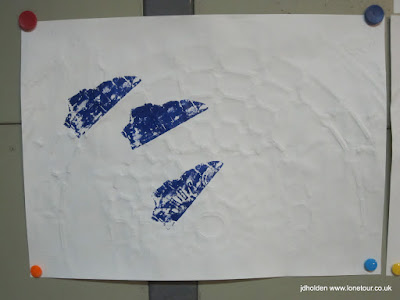
And this one gave a sense of meandering across the page, and off the paper.
From first ideas

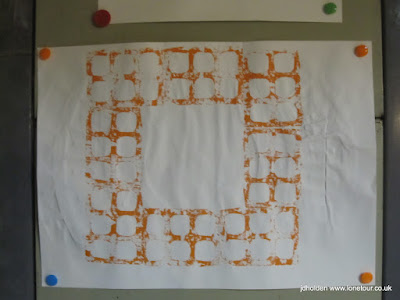
It was these first attempts that gave me the idea of looking to create a series based on typical art adjectives (see an earlier blog for more on this). And this arrangement of the same "word" created, for me, a sense of floating unmoving light solidity. Not like a balloon which is shaken by the wind, but like an alien spaceship, with no apparent source of energy keeping it mid-air.

From first ideas