Why? A question of justification.
The other day I was chatting with Miguel (one on the collaborators on my "Prometheus" project) about the use of scaffolding in a dance/performace. He suggested that it should be gold. Later he got some dental floss to talk about the idea of making a "web" in the shape of an Abstract Head, that would connect the audience, or for them to break as they left the theatre.
And then I realised what "justification" means. It means asking "Why?" about everything that we do. I don't want my audience to break things as they leave. Why? Because "Prometheus" is a work of creation. I want to create, to create, to create.
Everything I hate about Contemporary Art.
Here's some Altermodernism:
I hate video as art.
I hate conceptualism as art.
I hate needing to explain process as art.
I hate performace as art.
I hate interaction as art.
I hate politics as art.
I hate sound as art.
That's a fairly good list for Breaking the Boundaries.
Here's some brilliant art that ticks all my hates. Well done Marcus Coates.
Here's a fabulous review of Marcus Coates.
And you can see an installation view of "Birdsong" here.
I hate video as art.
I hate conceptualism as art.
I hate needing to explain process as art.
I hate performace as art.
I hate interaction as art.
I hate politics as art.
I hate sound as art.
That's a fairly good list for Breaking the Boundaries.
Here's some brilliant art that ticks all my hates. Well done Marcus Coates.
Here's a fabulous review of Marcus Coates.
And you can see an installation view of "Birdsong" here.
Emancipation
At an exhibition... even when inert forms are involved, there is the possibility of an immediate discussion, in both senses of the term. I see and perceive, I comment, and I evolve in a unique space and time. Art is the place that produces a specific sociability. It remains to be seen what the status of this is in the set of "states of encounter" proposed by the City. How is an art focused on the production of such forms of conviviality capable of relaunching the modern emancipation plan, by complementing it? How does it permit the development of new political and cultural designs?
http://www.creativityandcognition.com/blogs/legart/wp-content/uploads/2006/07/Borriaud.pdf
Art is a state of encounter.
What is the encounter with my art? Well, most of it is un-encountered for. The immediate discussions available at an art exhibition are:
1. the viewer with the work
2. the viewer with another, known, viewer
3. the viewer with another, unknown, viewer
4. the viewer with the gallerist
5. the gallerist with the viewer
6. the viewer with the artist
7. the artist with the viewer
How does art emancipate?
http://www.creativityandcognition.com/blogs/legart/wp-content/uploads/2006/07/Borriaud.pdf
Art is a state of encounter.
What is the encounter with my art? Well, most of it is un-encountered for. The immediate discussions available at an art exhibition are:
1. the viewer with the work
2. the viewer with another, known, viewer
3. the viewer with another, unknown, viewer
4. the viewer with the gallerist
5. the gallerist with the viewer
6. the viewer with the artist
7. the artist with the viewer
How does art emancipate?
Graffiti Sculpture 1
At last I have put a graffiti sculpture out there. It was spotted by one of the people from my studio... so other people must have seen it too. It's gone now (within four days), probably the parks people when they came to do some tidying up.
JD Holden - Abstract Head [Series2] (Ripley)
YouTube - Les Sept Planches de la ruse
Although based on a Tangram, this shows one direction my Abstract Heads work could take.
video art ideas
http://old.gold.ac.uk/art/exhibitions/archive/mfa2009/pages/nh/03.html
I rather liked the idea in this video.... playing it backwards gives a weird feel to the movement of the material. It would be interesting to explore the idea of filming a dancer, and playing it backwards as the dancer performs in front of the video.
LS Lowry
"...the art of the painter.....that richest vein of creative vision in which essence is distilled from subject and married to idea. It is a visionary genius peculiar to the English masters. The French call it symbolism. The English see it as a strain of native eccentricity." (p.12 Levy, The Paintings of L.S. Lowry, 1975)
"...Lowry ventures no answer. Like other great artists, he only poses questions." (p.18 Levy, The Paintings of L.S. Lowry, 1975)
It is the measure of great, architectural composition - composition in the classic mould - that the eye always finds a point of ultimate reference: a core of stillness, or of simulation, which exists at the heart of the construction, and beyond all the impedimentia of incidental detail. (p.12 Levy, The Paintings of L.S. Lowry, 1975)
"Albert Camus has written: 'I know from my own experience, that a man's life-work is nothing but a long journey to find again, by all the detours of art, the two or three powerful images upon which his whole being is opened for the first time.'"(p.12 Levy, The Paintings of L.S. Lowry, 1975)
"...Lowry ventures no answer. Like other great artists, he only poses questions." (p.18 Levy, The Paintings of L.S. Lowry, 1975)
It is the measure of great, architectural composition - composition in the classic mould - that the eye always finds a point of ultimate reference: a core of stillness, or of simulation, which exists at the heart of the construction, and beyond all the impedimentia of incidental detail. (p.12 Levy, The Paintings of L.S. Lowry, 1975)
"Albert Camus has written: 'I know from my own experience, that a man's life-work is nothing but a long journey to find again, by all the detours of art, the two or three powerful images upon which his whole being is opened for the first time.'"(p.12 Levy, The Paintings of L.S. Lowry, 1975)
I'm Clean
My mum and I went to an "Open Doors" at Galeria Nomada and had fun doing this....


What we didn't realise was that we were supposed to be "rethinking our misdeeds"... someone had already made the "Ignor Old people" sign, which my mum decided to counter... I just put up one of my art slogans...
http://www.estudio-nomada.com/exposities/im-clean
So, yes, labels are important!! without the "Label" or instructions, we didn't know what we were supposed to be doing. Not that I'd have bothered if I'd known it was meant to be therapy, not art!
What we didn't realise was that we were supposed to be "rethinking our misdeeds"... someone had already made the "Ignor Old people" sign, which my mum decided to counter... I just put up one of my art slogans...
http://www.estudio-nomada.com/exposities/im-clean
So, yes, labels are important!! without the "Label" or instructions, we didn't know what we were supposed to be doing. Not that I'd have bothered if I'd known it was meant to be therapy, not art!
The Participatory Museum
https://www.createspace.com/3431037
Signatura 069:30 SIM
Autor Simon , Nina
Títol The participatory museum / by Nina Simon.
Publicació Santa Cruz, Calif. : Museum, c2010.
Descripció v, 352, [19] p. : il. ; 23 cm.
Signatura 069:30 SIM
Autor Simon , Nina
Títol The participatory museum / by Nina Simon.
Publicació Santa Cruz, Calif. : Museum, c2010.
Descripció v, 352, [19] p. : il. ; 23 cm.
Ai Weiwei: Works 2004-2007
Philip Tinari, Charles Merewether, Ai Weiwei (Editor), Urs Meile (Editor), Peter Pakesch (Editor)
Publisher: JRP|RINGier
ISBN: 3905829274 DDC: 709 Edition: Paperback; 2008-08-01
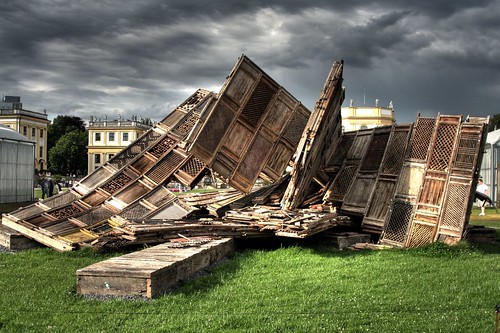
p. 180 "Ironically, TEMPLATE as a structure collapsed under heavy weather conditions some days after its inauguration. Perhaps it was a fitting end, symbolising the fragility of the proposed template and the fate of a form that, made of fragments, is little more than a void. This is the "condition of time", a condition of temporality that governs everything and therefore offers no guarantee as to what will come after. One can only create the conditions of possibility through the actualisations that reveal the material force of its being. These actualisations are what is given at the time but they contain, nonetheless, a potentiality or virtuality which is then to be determined. This the is the freedom of the work itself, and in turn the freedom of its audience." Charles Merewether
Philip Tinari, Charles Merewether, Ai Weiwei (Editor), Urs Meile (Editor), Peter Pakesch (Editor)
Publisher: JRP|RINGier
ISBN: 3905829274 DDC: 709 Edition: Paperback; 2008-08-01
p. 180 "Ironically, TEMPLATE as a structure collapsed under heavy weather conditions some days after its inauguration. Perhaps it was a fitting end, symbolising the fragility of the proposed template and the fate of a form that, made of fragments, is little more than a void. This is the "condition of time", a condition of temporality that governs everything and therefore offers no guarantee as to what will come after. One can only create the conditions of possibility through the actualisations that reveal the material force of its being. These actualisations are what is given at the time but they contain, nonetheless, a potentiality or virtuality which is then to be determined. This the is the freedom of the work itself, and in turn the freedom of its audience." Charles Merewether
One thing has nothing to do with the other...
An occasional series of sculptures looking at ideas, forms and symbols. And a good thing to do while waiting for paint to dry. Or to use up spare paint.
A Haiku
Juxtaposition
Heterogeneity
Serendipity
http://collectionsonline.lacma.org/mwebcgi/mweb.exe?request=record%3Bid=75845%3Btype=101
Barnett Newman "Here 1" 1950
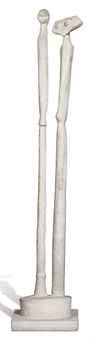
Louise Bourgeois "The Listening One" 1947 Bronze, painted white
Max Ernst Moon Asparagus 1953
A Haiku
Juxtaposition
Heterogeneity
Serendipity
http://collectionsonline.lacma.org/mwebcgi/mweb.exe?request=record%3Bid=75845%3Btype=101
Barnett Newman "Here 1" 1950
Louise Bourgeois "The Listening One" 1947 Bronze, painted white
Max Ernst Moon Asparagus 1953
Greenberg and Empty Nothingness
Clement Greenberg
Clement Greenberg: the collected essays and criticism
Clement Greenberg, John O'Brian (Editor)
Publisher: Chicago : University of Chicago Press, 1986-
ISBN: 0226306208 DDC: 700 LCC: N7445.2
http://www.tate.org.uk/tateetc/issue8/erasuregenteel.htm
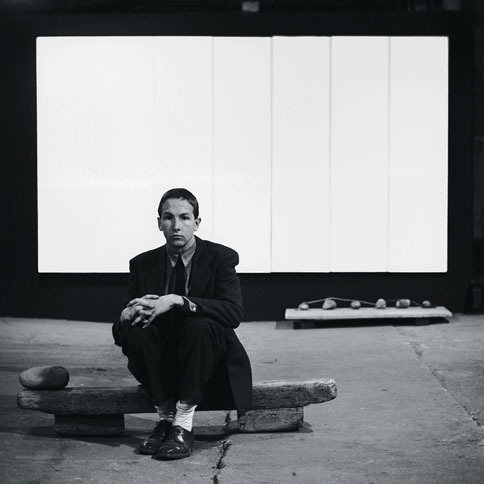
"Photograph of Robert Rauschenberg seated on Untitled (Elemental Sculpture) with White Painting (seven panel) behind him at the basement of Stable Gallery, New York (1953).
© Photograph: Allan Grant, Life Magazine © Time Warner Inc/Robert Rauschenberg/VAGA, New York and DACS, London 2006
Rauschenberg's moves in white are part of the grand gesture that his early work strove for and often achieved. His colleague John Cage recognised this when he wrote: "The white paintings were airports for the lights, shadows and particles." Rauschenberg was able to make nothing the subject of a painting in a way that Cage would, after him, make nothing the subject of a piece of music. Then everything could enter in. "Having made the empty canvases (a canvas is never empty), Rauschenberg became the giver of gifts." The timing of these acts was crucial; it was a different response to the Second World War and the atom bomb. Unlike the existentialism of Giacometti, which depicted man alone in the universe, Rauschenberg's emptiness has a positive tonality, and although he in part rejected the serious themes of his Abstract Expressionist predecessors, his White Paintings have nothing of the humour of the Surrealists." accessed 6/5/11
p.254 "Aesthetic surprise comes from inspiration and sensibility as well as being abreast of the artistic times."
p.255 "The best of Monet´s lily pad paintings... are not made any less challenging and arduous ...by their nominally sweet colour. Equations like these cannot be thought out in advance, they can only be felt and discovered."
http://annetruitt.org/work/sculpture/
p.256 "That presence as achieved through size was aesthetically extraneous, I already knew. That presence as achieved through the look of non-art was likewise aesthetically extraneous, I did not yet know. Truitt´s sculpture had this kind of presence but did not hide behind it."
Clement Greenberg: the collected essays and criticism
Clement Greenberg, John O'Brian (Editor)
Publisher: Chicago : University of Chicago Press, 1986-
ISBN: 0226306208 DDC: 700 LCC: N7445.2
http://www.tate.org.uk/tateetc/issue8/erasuregenteel.htm
"Photograph of Robert Rauschenberg seated on Untitled (Elemental Sculpture) with White Painting (seven panel) behind him at the basement of Stable Gallery, New York (1953).
© Photograph: Allan Grant, Life Magazine © Time Warner Inc/Robert Rauschenberg/VAGA, New York and DACS, London 2006
Rauschenberg's moves in white are part of the grand gesture that his early work strove for and often achieved. His colleague John Cage recognised this when he wrote: "The white paintings were airports for the lights, shadows and particles." Rauschenberg was able to make nothing the subject of a painting in a way that Cage would, after him, make nothing the subject of a piece of music. Then everything could enter in. "Having made the empty canvases (a canvas is never empty), Rauschenberg became the giver of gifts." The timing of these acts was crucial; it was a different response to the Second World War and the atom bomb. Unlike the existentialism of Giacometti, which depicted man alone in the universe, Rauschenberg's emptiness has a positive tonality, and although he in part rejected the serious themes of his Abstract Expressionist predecessors, his White Paintings have nothing of the humour of the Surrealists." accessed 6/5/11
p.254 "Aesthetic surprise comes from inspiration and sensibility as well as being abreast of the artistic times."
p.255 "The best of Monet´s lily pad paintings... are not made any less challenging and arduous ...by their nominally sweet colour. Equations like these cannot be thought out in advance, they can only be felt and discovered."
http://annetruitt.org/work/sculpture/
p.256 "That presence as achieved through size was aesthetically extraneous, I already knew. That presence as achieved through the look of non-art was likewise aesthetically extraneous, I did not yet know. Truitt´s sculpture had this kind of presence but did not hide behind it."
Thoughts on a graffiti sculpture project.
My plan is to put four or five small scale concrete or plaster sculptures on "plinths" a number of locations in Barcelona. They will have to be small enough and light enough to carry on my motorbike from the studio. Each one will have a label with a QR code giving information about the work, the location of the next work and asking for photos of the work to be uploaded. I will document the sculptures on site through video and photos, and possibly interact with the audience.


So why am I doing this?
To make some more work public, for free. To clear some space in my studio. To create and document some public art. To talk to people about my art. To try out QR code technology. To make myself feel like an artist. To finally get done an idea I had several months ago.
Update: 4/5/11
So why have I been avoiding this?
Well, partly because it´s a bit scary. But also because I´m not completely comfortable with my concrete sculptures. And I´d like to involve some other people. But now I have a new plan... to work with GAP (Gracia Arts Project) and spend a day together making some AH sculptures, and then the next day to take them out into the streets of the Gotico and leave them around. Depending on the number of people I can get involved, I hope to make 5 or 6 sculptures for this project. And we´ll see how long they last. Hopefully we´ll have a couple of people for each sculpture, or a rotating shift system, so I can have a record of the public looking at them, photographing them etc.
So why am I doing this?
To make some more work public, for free. To clear some space in my studio. To create and document some public art. To talk to people about my art. To try out QR code technology. To make myself feel like an artist. To finally get done an idea I had several months ago.
Update: 4/5/11
So why have I been avoiding this?
Well, partly because it´s a bit scary. But also because I´m not completely comfortable with my concrete sculptures. And I´d like to involve some other people. But now I have a new plan... to work with GAP (Gracia Arts Project) and spend a day together making some AH sculptures, and then the next day to take them out into the streets of the Gotico and leave them around. Depending on the number of people I can get involved, I hope to make 5 or 6 sculptures for this project. And we´ll see how long they last. Hopefully we´ll have a couple of people for each sculpture, or a rotating shift system, so I can have a record of the public looking at them, photographing them etc.
Abstract Heads Experiments
Taking things out, putting them back in again.
Sleeping Snooze. Not a graveyard, but reclining.
Postproduction: culture as screenplay: how art reprograms the world
Postproduction
Postproduction: culture as screenplay: how art reprograms the world
Nicolas Bourriaud; [editor, Caroline Schneider; translation, Jeanine Herman]
Publisher: New York : Lukas & Sternberg, c2002.
ISBN: 0971119309 DDC: 709.049
https://docs.google.com/viewer?url=http%3A%2F%2Fwww9.georgetown.edu%2Ffaculty%2Firvinem%2Ftheory%2FBourriaud-Postproduction2.pdf
what if the platform, the plinth, becomes the work?
what if we take an AH and put it on a gaudy platform?
why does the plane of the ground have to be flat?

"Post-production refers to a zone of working" - what "PP" would I do to an AH?
" inventing protocols of use for all existing modes of representation and formal structures. It is a matter of seizing all the codes of a culture, all the forms of everyday life, the workds of the global patrimony, and making them function. To learn how to use forms is above all to know how to make them one´s own, to inhabit them." p.12
copy other people.... and learn from this what you need to learn
Sarah Morris, Household gloss on Canvas http://i1.exhibit-e.com/petzel/afc98954.jpg
https://blogger.googleusercontent.com/img/b/R29vZ2xl/AVvXsEhjXDUlE9OxjNiUG-d4Fnj8bm3lYhLSjfOBKvyh5MYx1r3x7qljspv2YFjUqt6Q3IKkAatjodStMqrtz1wvv5Zu-dz3p51ZgtNCgUzJqh8nvyx5sxIo63_5_iAYBcJVPp05VxunUpJYcUE/s320/Sarah+Morris+Petzel.jpg
p.17 "The supremacy of cultures of appropriation and the reprocessing of forms calls
for an ethics: to paraphrase Philippe Thomas, artworks belong to
everyone. Contemporary art tends to abolish the ownership of forms,
or in any case to shake up the old jurisprudence. Are we heading
toward a culture that would do away with copyright in favor of a
policy allowing free access to works, a sort of blueprint for a com-
mmunism of forms"
p. 18"The Situationists extolled la derive (or drift), a technique
of navigating through various urban settings as if they were film sets.
These situations, which had to be constructed, were experienced,
ephemeral, and immaterial works, an art of the passing of time resis-
tant to any fixed limitations. Their task was to eradicate, with tools
borrowed from the modern lexicon, the mediocrity of an alienated
everyday life in which the artwork served as a screen, or a consola-
tion, representing nothing other than the materialization of a lack."
p19."Using a remote
control is also production, the timid production of alienated leisure
time: with your finger on the button, you construct a program."
p.20"The quality of a work depends on the trajectory it describes in the cul-
tural landscape. It constructs a linkage between forms, signs, and
images."
p.24 "Citizens of international public space, they tra-
verse these spaces for a set amount of time before adopting new
identities; they are universally exotic. They make the acquaintance of
people of all sorts, the way one might hook up with strangers during
a long trip. That is why one of the formal models of Tiravanija's work
is the airport, a transitional place in which individuals go from boutique
to boutique and from information desk to information desk and join
the temporary micro-communities that gather while waiting to reach
a destination. Tiravanija's works are the accessories and decor of a
planetary scenario, a script in progress whose subject is how to in-
habit the world without residing anywhere."
that's all well and good, but people tend to isolate themselves at airports... forming queues NOT talking to each other...
p26 "Art is the product of a gap."
p.27 "Why not use art to look at the world, rather than stare sullenly at the
forms it presents?"
erm... because it's supposed to be reflecting the world as the artist sees it????
Postproduction: culture as screenplay: how art reprograms the world
Nicolas Bourriaud; [editor, Caroline Schneider; translation, Jeanine Herman]
Publisher: New York : Lukas & Sternberg, c2002.
ISBN: 0971119309 DDC: 709.049
https://docs.google.com/viewer?url=http%3A%2F%2Fwww9.georgetown.edu%2Ffaculty%2Firvinem%2Ftheory%2FBourriaud-Postproduction2.pdf
what if the platform, the plinth, becomes the work?
what if we take an AH and put it on a gaudy platform?
why does the plane of the ground have to be flat?

"Post-production refers to a zone of working" - what "PP" would I do to an AH?
" inventing protocols of use for all existing modes of representation and formal structures. It is a matter of seizing all the codes of a culture, all the forms of everyday life, the workds of the global patrimony, and making them function. To learn how to use forms is above all to know how to make them one´s own, to inhabit them." p.12
copy other people.... and learn from this what you need to learn
Sarah Morris, Household gloss on Canvas http://i1.exhibit-e.com/petzel/afc98954.jpg
https://blogger.googleusercontent.com/img/b/R29vZ2xl/AVvXsEhjXDUlE9OxjNiUG-d4Fnj8bm3lYhLSjfOBKvyh5MYx1r3x7qljspv2YFjUqt6Q3IKkAatjodStMqrtz1wvv5Zu-dz3p51ZgtNCgUzJqh8nvyx5sxIo63_5_iAYBcJVPp05VxunUpJYcUE/s320/Sarah+Morris+Petzel.jpg
p.17 "The supremacy of cultures of appropriation and the reprocessing of forms calls
for an ethics: to paraphrase Philippe Thomas, artworks belong to
everyone. Contemporary art tends to abolish the ownership of forms,
or in any case to shake up the old jurisprudence. Are we heading
toward a culture that would do away with copyright in favor of a
policy allowing free access to works, a sort of blueprint for a com-
mmunism of forms"
p. 18"The Situationists extolled la derive (or drift), a technique
of navigating through various urban settings as if they were film sets.
These situations, which had to be constructed, were experienced,
ephemeral, and immaterial works, an art of the passing of time resis-
tant to any fixed limitations. Their task was to eradicate, with tools
borrowed from the modern lexicon, the mediocrity of an alienated
everyday life in which the artwork served as a screen, or a consola-
tion, representing nothing other than the materialization of a lack."
p19."Using a remote
control is also production, the timid production of alienated leisure
time: with your finger on the button, you construct a program."
p.20"The quality of a work depends on the trajectory it describes in the cul-
tural landscape. It constructs a linkage between forms, signs, and
images."
p.24 "Citizens of international public space, they tra-
verse these spaces for a set amount of time before adopting new
identities; they are universally exotic. They make the acquaintance of
people of all sorts, the way one might hook up with strangers during
a long trip. That is why one of the formal models of Tiravanija's work
is the airport, a transitional place in which individuals go from boutique
to boutique and from information desk to information desk and join
the temporary micro-communities that gather while waiting to reach
a destination. Tiravanija's works are the accessories and decor of a
planetary scenario, a script in progress whose subject is how to in-
habit the world without residing anywhere."
that's all well and good, but people tend to isolate themselves at airports... forming queues NOT talking to each other...
p26 "Art is the product of a gap."
p.27 "Why not use art to look at the world, rather than stare sullenly at the
forms it presents?"
erm... because it's supposed to be reflecting the world as the artist sees it????
Maturity in Art
How do we become mature as artists?
Longevity?
Productivity?
Consistency?
Experimentalism?
Direction?
Longevity?
Productivity?
Consistency?
Experimentalism?
Direction?
9780226306209
1965 Contemporary Sculpture: Anthony Caro
Words used by Greenberg:
integrally abstract contours profiles vectors lines of force direction satisfaction weight relations of its discrete parts syntax radical unlikeness to nature structural logic spinal nodal symmetry surreptitiously indirectly planar and liner shapes agglomerations enclosing silhouette internal pattern readily apparent axes centres of interest tangentially ex-centrically ground plan echo interlock superstructure elevation unity confusion radical rejection of monolithic structure pictorial many different, dramatically different points of view roundness paradoxical vocabulary of forms depth surfaces edges rectilinear changes of direction strictly rectangular calligraphic cursive curved forms necessarily angular sparingly rect-angular tilting tipping odd-angled cantilevering sprawling cursiveness separate frontal move fuse light heavy interwoven fugally open closed irregular regular lightness regularity relationships rectangular boxlike plain emphasised symmetry forthright symmetry startling effect syntactic massiveness literal massiveness smaller lighter thinner foursquare squatness rectangular symmetry less fragile inner and outer play intrinsically purely limpidly masterpieces low centre of gravity constant features originality perfect fulfilment ground-flung wide-open enclosures L T relieved vertical elements strike heroic grand-manner resonantly less expectedly historic connotations roots Perpendicular Gothic grand sublime peculiarly English aspiration achieved weightlessness belongs distinctively non-monolithic sprung Cubist collage originality of style denying weight lowering raising possibility opening extending ground-hugging laterally inflecting vertically accents lateral movement plane of the ground base foil challenge force of gravity applied colour high-keyed off shades deprive metal surfaces tactile connotations render optical essential importance art of colour satisfactory unsuccessful transcend specific combination detract quality impression aesthetically literally provisional changed decisively quality secondary unnecessary originality stylistic formal ingenuity novelty taste challenged changes expands make room product of necessity compelled vision
Words used by Greenberg:
integrally abstract contours profiles vectors lines of force direction satisfaction weight relations of its discrete parts syntax radical unlikeness to nature structural logic spinal nodal symmetry surreptitiously indirectly planar and liner shapes agglomerations enclosing silhouette internal pattern readily apparent axes centres of interest tangentially ex-centrically ground plan echo interlock superstructure elevation unity confusion radical rejection of monolithic structure pictorial many different, dramatically different points of view roundness paradoxical vocabulary of forms depth surfaces edges rectilinear changes of direction strictly rectangular calligraphic cursive curved forms necessarily angular sparingly rect-angular tilting tipping odd-angled cantilevering sprawling cursiveness separate frontal move fuse light heavy interwoven fugally open closed irregular regular lightness regularity relationships rectangular boxlike plain emphasised symmetry forthright symmetry startling effect syntactic massiveness literal massiveness smaller lighter thinner foursquare squatness rectangular symmetry less fragile inner and outer play intrinsically purely limpidly masterpieces low centre of gravity constant features originality perfect fulfilment ground-flung wide-open enclosures L T relieved vertical elements strike heroic grand-manner resonantly less expectedly historic connotations roots Perpendicular Gothic grand sublime peculiarly English aspiration achieved weightlessness belongs distinctively non-monolithic sprung Cubist collage originality of style denying weight lowering raising possibility opening extending ground-hugging laterally inflecting vertically accents lateral movement plane of the ground base foil challenge force of gravity applied colour high-keyed off shades deprive metal surfaces tactile connotations render optical essential importance art of colour satisfactory unsuccessful transcend specific combination detract quality impression aesthetically literally provisional changed decisively quality secondary unnecessary originality stylistic formal ingenuity novelty taste challenged changes expands make room product of necessity compelled vision
Barry Flanagan
Título Barry Flanagan Libros/Monografias
Autor(es) Flanagan, Barry (Escultor), 1941- (Autor)
Publicación España : Fundacion la Caixa, 1993
Descripción Física 145p. : il.
Idioma Español;
ISBN 847664423X
p.136 "Whilst interrupting a carver's work, I realised that a conductor reaching for the first violinist's bow isn't recognising his place.
In the workshop the purpose of drawings has changed, now included in the practice, rather than put on the gallery wall."
p.138 "In Japanese myth the Gods commanded all the animals to make presents to them, Whilst all the other animals brought gifts the hare is honoured because it made a barbecue of itself. Analogous to the role of talent...... His guardian deities are surely Thor and Hermes."
"the opportunity of a print to me, as a sculptor, somehow speaks of that commitment to be responsible and exposed - to have the presence of mind to draw."
Autor(es) Flanagan, Barry (Escultor), 1941- (Autor)
Publicación España : Fundacion la Caixa, 1993
Descripción Física 145p. : il.
Idioma Español;
ISBN 847664423X
p.136 "Whilst interrupting a carver's work, I realised that a conductor reaching for the first violinist's bow isn't recognising his place.
In the workshop the purpose of drawings has changed, now included in the practice, rather than put on the gallery wall."
p.138 "In Japanese myth the Gods commanded all the animals to make presents to them, Whilst all the other animals brought gifts the hare is honoured because it made a barbecue of itself. Analogous to the role of talent...... His guardian deities are surely Thor and Hermes."
"the opportunity of a print to me, as a sculptor, somehow speaks of that commitment to be responsible and exposed - to have the presence of mind to draw."
The Work of Art in the Age of Mechanical Reproduction
Walter Benjamin 1936
"Even the most perfect reproduction of a work is lacking one element: its presence in time and space, its unique existence at the place where it happens to be. This unique existence of the work of art determined the history to which it was subject throughout the time of its existence. This includes the changes it may have suffered in physical condition over the years, as well as the various changes in its ownership. The traces of the first can be revealed only by chemical or physical analyses which it is impossible to perform on a reproduction; changes of ownership are subject to a tradition which must be traced from the situation of the original.
The presence of the original is the prerequisite to the concept of authenticity."
so there is pedigree, heritage in authentic art... the work become symbolic of the cult
"When the age of mechanical reproduction separated art from its basis in cult, the semblance of its autonomy disappeared forever."
Anyone can have a copy of a Picasso on their wall. But only one man can have the original that Picasso painted on his wall. But we have moved so far away from this now.... Bridget Riley, Damien Hirst lay not one finger on their work, but their cults exist nonetheless. Mechanical reproduction can help with the idea of "fashionability", but the original is still worth having.
My confusion about the art world is that I wouldn´t want to buy "an original signed print" by any artist. What´s the point in having a mechanical copy? I want an original on my wall, one that has specific meaning to me, if to no-one else. Do people have more money that sense? Or is my sense so very different to other people´s?
"Even the most perfect reproduction of a work is lacking one element: its presence in time and space, its unique existence at the place where it happens to be. This unique existence of the work of art determined the history to which it was subject throughout the time of its existence. This includes the changes it may have suffered in physical condition over the years, as well as the various changes in its ownership. The traces of the first can be revealed only by chemical or physical analyses which it is impossible to perform on a reproduction; changes of ownership are subject to a tradition which must be traced from the situation of the original.
The presence of the original is the prerequisite to the concept of authenticity."
so there is pedigree, heritage in authentic art... the work become symbolic of the cult
"When the age of mechanical reproduction separated art from its basis in cult, the semblance of its autonomy disappeared forever."
Anyone can have a copy of a Picasso on their wall. But only one man can have the original that Picasso painted on his wall. But we have moved so far away from this now.... Bridget Riley, Damien Hirst lay not one finger on their work, but their cults exist nonetheless. Mechanical reproduction can help with the idea of "fashionability", but the original is still worth having.
My confusion about the art world is that I wouldn´t want to buy "an original signed print" by any artist. What´s the point in having a mechanical copy? I want an original on my wall, one that has specific meaning to me, if to no-one else. Do people have more money that sense? Or is my sense so very different to other people´s?
Critical terms for art history
edited by Robert S. Nelson and Richard Shiff
Publisher: Chicago : University of Chicago Press, c1996.
ISBN: 0226571653 DDC: 701.4 LCC: N34 Edition: (paper : acid-free paper)
Schiff "Originality"
p.107 Modernists have a certain hubris. Often arguing that they lack true precedent, they conceive of themselves (not their principles) as original and seek originality by realising their inner feelings, thoughts and character. Accordingly, romantics and modernists associate artistic authenticity with an expressive manner so autonomous that it must also appear innovative, in opposition to the value a classicist might locate in selective repetition. The lesson is this: classics repeat; moderns should not, except when re-iteraring what belongs to each one of them alone, their personal style.
p.108
To seek originality by stressing one´s deviation from others has consequences in the social realm, it encourages a certain personal competition which in turn has economic implications. Artists sell their unique difference, but not always easily. Modernists saw the irony of struggling for market recognition in a world ruled by fashion, which itself follows a principle of uniqueness of a peculiar kind: fashion is novelty produced in multiple and multiauthored edition.
So, do I need to copy others in my work? Somewhere along the line, the originality that I see in my work (Abstract Heads, clearly; and when I find a specific "language" the Mies series too) needs to be replicated, copied, fashioned, editioned.
edited by Robert S. Nelson and Richard Shiff
Publisher: Chicago : University of Chicago Press, c1996.
ISBN: 0226571653 DDC: 701.4 LCC: N34 Edition: (paper : acid-free paper)
Schiff "Originality"
p.107 Modernists have a certain hubris. Often arguing that they lack true precedent, they conceive of themselves (not their principles) as original and seek originality by realising their inner feelings, thoughts and character. Accordingly, romantics and modernists associate artistic authenticity with an expressive manner so autonomous that it must also appear innovative, in opposition to the value a classicist might locate in selective repetition. The lesson is this: classics repeat; moderns should not, except when re-iteraring what belongs to each one of them alone, their personal style.
p.108
To seek originality by stressing one´s deviation from others has consequences in the social realm, it encourages a certain personal competition which in turn has economic implications. Artists sell their unique difference, but not always easily. Modernists saw the irony of struggling for market recognition in a world ruled by fashion, which itself follows a principle of uniqueness of a peculiar kind: fashion is novelty produced in multiple and multiauthored edition.
So, do I need to copy others in my work? Somewhere along the line, the originality that I see in my work (Abstract Heads, clearly; and when I find a specific "language" the Mies series too) needs to be replicated, copied, fashioned, editioned.
Altermodernism and Me.
It's really interesting to see how my exploratory works (before starting the Masters) reflect the ideas in the Altermodern Manifesto:
Increased communication, travel and migration are affecting the way we live

These images were made in Huddersfield during a period of time when I was moving to Barcelona. They reflect both my old life and my new life, with ideas and motifs appropriated from at least four artists.


The "Capvespres" series was born out of a number of journeys: to Colera to discover the word "capvspres"; around the streets of Barcelona to find the appropriated artworks; from Huddersfield where most of the life drawings were made; to Maine from whence the tissue paper came (re-cycled from my wedding); and, surfing the internet to look at images of collage. Without each of these journeys, this series could not have existed as it does now.
Our daily lives consist of journeys in a chaotic and teeming universe


Our quotidian journey is so full, it's impossible to see the manhole cover for the road.
Multiculturalism and identity is being overtaken by creolisation: Artists are now starting from a globalised state of culture


These works were made for a proposal for the "Drap Art" Exhibition 2008. "Drap" means junk or rubbish. They were made from my own rubbish, and I recycled ideas from major artists, who I think many Spanish people haven't even heard of; Carl Andre, Antony Gormley and Martin Creed. My artistic cultural heritage started in the UK, but has since taken in Europe, the USA and Central America. And the links here in Spain with South America, and the use of the internet to see what's happening in China, South Korea and the rest of the world all must have some influence on my thought process leading to my work.
This new universalism is based on translations, subtitling and generalised dubbing
Today's art explores the bonds that text and image, time and space, weave between themselves


Perhaps a bit literal, but these works are based on translating the phrase "Not everything you see is art" into Castellano and Catalan. The problem that needed solving was that the translation had to be in exactly 24 characters, so as to keep the form of the original layout of the words in English. We had to cheat, and use a sort of Argentinian Spanish. But I like cheating in my work.
The mechanical process of making these works involved cutting the letters out, placing them on a painted canvas and spray painting over them. The force of the spray caused some of the letters to move, producing some "ghosts" of letters. I used text to spell out literally what can be "seen through" the work where the canvas does not cover the whole of the frame.
Artists are responding to a new globalised perception. They traverse a cultural landscape saturated with signs and create new pathways between multiple formats of expression and communication.
These collages, created in old drawers, are not only colour studies, but cultural studies. Starting with pages from "Don Quixote" artistic cultural items (flyers, postcards etc. ) are combined with objects from the whole of life.


Here I am creating my own signs, my own language of forms, form, volumes, volume, constructs and constructions, all ultimately based on the question "who are you, where are you, why are you, when will you be?"


Increased communication, travel and migration are affecting the way we live
These images were made in Huddersfield during a period of time when I was moving to Barcelona. They reflect both my old life and my new life, with ideas and motifs appropriated from at least four artists.
The "Capvespres" series was born out of a number of journeys: to Colera to discover the word "capvspres"; around the streets of Barcelona to find the appropriated artworks; from Huddersfield where most of the life drawings were made; to Maine from whence the tissue paper came (re-cycled from my wedding); and, surfing the internet to look at images of collage. Without each of these journeys, this series could not have existed as it does now.
Our daily lives consist of journeys in a chaotic and teeming universe
Our quotidian journey is so full, it's impossible to see the manhole cover for the road.
Multiculturalism and identity is being overtaken by creolisation: Artists are now starting from a globalised state of culture


These works were made for a proposal for the "Drap Art" Exhibition 2008. "Drap" means junk or rubbish. They were made from my own rubbish, and I recycled ideas from major artists, who I think many Spanish people haven't even heard of; Carl Andre, Antony Gormley and Martin Creed. My artistic cultural heritage started in the UK, but has since taken in Europe, the USA and Central America. And the links here in Spain with South America, and the use of the internet to see what's happening in China, South Korea and the rest of the world all must have some influence on my thought process leading to my work.
This new universalism is based on translations, subtitling and generalised dubbing
Today's art explores the bonds that text and image, time and space, weave between themselves
Perhaps a bit literal, but these works are based on translating the phrase "Not everything you see is art" into Castellano and Catalan. The problem that needed solving was that the translation had to be in exactly 24 characters, so as to keep the form of the original layout of the words in English. We had to cheat, and use a sort of Argentinian Spanish. But I like cheating in my work.
The mechanical process of making these works involved cutting the letters out, placing them on a painted canvas and spray painting over them. The force of the spray caused some of the letters to move, producing some "ghosts" of letters. I used text to spell out literally what can be "seen through" the work where the canvas does not cover the whole of the frame.
Artists are responding to a new globalised perception. They traverse a cultural landscape saturated with signs and create new pathways between multiple formats of expression and communication.
These collages, created in old drawers, are not only colour studies, but cultural studies. Starting with pages from "Don Quixote" artistic cultural items (flyers, postcards etc. ) are combined with objects from the whole of life.
Here I am creating my own signs, my own language of forms, form, volumes, volume, constructs and constructions, all ultimately based on the question "who are you, where are you, why are you, when will you be?"
What school of art am I from?
Ripped from Wikipedia as a way of getting a very quick overview of schools of art.
Classicism is a specific genre of philosophy, expressing itself in literature, architecture, art, and music, which has Ancient Greek and Roman sources and an emphasis on society. It was particularly expressed in the Enlightenment, and the Age of Reason.
Classicism first made an appearance as such during the Italian renaissance when the fall of Byzantium and rising trade with the Islamic cultures brought a flood of knowledge about, and from, the antiquity of Europe. Until that time the identification with antiquity had been seen as a continuous history of Christendom from the conversion of Roman Emperor Constantine I. Renaissance classicism introduced a host of elements into European culture, including the application of mathematics and empiricism into art, humanism, literary and depictive realism, and formalism. Importantly it also introduced Polytheism, or "paganism", and the juxtaposition of ancient and modern.
The classicism of the Renaissance led to, and gave way to, a different sense of what was "classical" in the 16th and 17th centuries. In this period classicism took on more overtly structural overtones of orderliness, predictability, the use of geometry and grids, the importance of rigorous discipline and pedagogy, as well as the formation of schools of art and music. The court of Louis XIV was seen as the center of this form of classicism, with its references to the gods of Olympus as a symbolic prop for absolutism, its adherence to axiomatic and deductive reasoning, and its love of order and predictability.
I do like a certain orderliness in my work, but there's a good deal of serendipity that works against Classicism. Pedagogy is important to me in general, and some of my work involves juxtaposition. It's interesting that it was foreign influences, trade, movement that enabled this ism to appear, and there may be links to Altermodernism (see below)
Cubist In cubist artworks, objects are broken up, analyzed, and re-assembled in an abstracted form—instead of depicting objects from one viewpoint, the artist depicts the subject from a multitude of viewpoints to represent the subject in a greater context. Often the surfaces intersect at seemingly random angles, removing a coherent sense of depth. The background and object planes interpenetrate one another to create the shallow ambiguous space, one of cubism's distinct characteristics.
I guess I do this. But instead of re-assembling on one surface, I put them into three separate surfaces, making the viewer move from form to form.
Constructivist was an artistic and architectural movement that originated in Russia from 1919 onward which rejected the idea of autonomous art in favour of art as a practice directed towards social purposes.
My art has no social purpose, just personal purpose. I don't make art to teach, to inform, to change society. I make art for individuals to put in their spaces. Even monumental or public art is like this.
Futurist expressed a passionate loathing of everything old, especially political and artistic tradition.
I love futuristic art. I don't loathe anything.
Formalist is the concept that a work's artistic value is entirely determined by its form--the way it is made, its purely visual aspects, and its medium. Formalism emphasizes compositional elements such as color, line, shape and texture rather than realism, context, and content. In visual art, formalism is a concept that posits that everything necessary to comprehending a work of art is contained within the work of art. The context for the work, including the reason for its creation, the historical background, and the life of the artist, is considered to be of secondary importance. Formalism is an approach to understanding art.
I hope that my work can be seen as of and by itself. But I like telling the story of my art. And I certainly don't plan every line or plane.
Modern includes artistic works produced during the period extending roughly from the 1860s to the 1970s, and denotes the style and philosophy of the art produced during that era. The term is usually associated with art in which the traditions of the past have been thrown aside in a spirit of experimentation. Modern artists experimented with new ways of seeing and with fresh ideas about the nature of materials and functions of art. A tendency toward abstraction is characteristic of much modern art.
I embrace the traditions of the past, especially the modern past. I guess there is a tendency towards abstraction in my work.
Modernist Modernism was a revolt against the conservative values of realism. Arguably the most paradigmatic motive of modernism, is the rejection of tradition, and its reprise, incorporation, rewriting, recapitulation, revision and parody in new forms. Modernism rejected the lingering certainty of Enlightenment thinking, and also that of the existence of a compassionate, all-powerful Creator God.
In general, the term modernism encompasses the activities and output of those who felt the "traditional" forms of art, architecture, literature, religious faith, social organization and daily life were becoming outdated in the new economic, social, and political conditions of an emerging fully industrialized world. The poet Ezra Pound's 1934 injunction to "Make it new!" was paradigmatic of the movement's approach towards the obsolete. Another paradigmatic exhortation was articulated by philosopher and composer Theodor Adorno, which in the 1940s, invited to challenge conventional surface coherence and appearance of harmony, typical of the rationality of Enlightenment thinking. A salient characteristic of modernism is self-consciousness. This often led to experiments with form, and work that draws attention to the processes and materials used (and to the further tendency of abstraction).
Fifty years ago, I would have been proudly Modernist. And I am happy enough that the process and materials used in my abstraction can be seen. But I want to make it new by looking at the old.
Remodernist The Remodernism manifesto was published on March 1, 2000 to promote vision, authenticity and self-expression, with an emphasis on painting, and subtitled "towards a new spirituality in art." Its premise is that the potential of the modernist vision has not been fulfilled, that its development has been in the wrong direction and that this vision needs to be reclaimed, redefined and redeveloped. It advocates the search for truth, knowledge and meaning, and challenges formalism.
It has a short introduction, summing up: "Modernism has progressively lost its way, until finally toppling into the bottomless pit of Postmodern balderdash." This is followed by 14 numbered points, stressing bravery, individuality, inclusiveness, communication, humanity and the perennial against nihilism, scientific materialism and the "brainless destruction of convention." Point 7 states:
Spirituality is the journey of the soul on earth. Its first principle is a declaration of intent to face the truth. Truth is what it is, regardless of what we want it to be. Being a spiritual artist means addressing unflinchingly our projections, good and bad, the attractive and the grotesque, our strengths as well as our delusions, in order to know ourselves and thereby our true relationship with others and our connection to the divine.
Point 9 states: "Spiritual art is not religion. Spirituality is humanity's quest to understand itself and finds its symbology through the clarity and integrity of its artists." Point 12 links its use of the word "God" to enthusiasm — from the Greek root "en theos" (to be possessed by God).
The summary at the end starts, "It is quite clear to anyone of an uncluttered mental disposition that what is now put forward, quite seriously, as art by the ruling elite, is proof that a seemingly rational development of a body of ideas has gone seriously awry," and finds the solution is a spiritual renaissance because "there is nowhere else for art to go. Stuckism's mandate is to initiate that spiritual renaissance now."
I started looking at Remondernism with interest. And then we got to the spirituality bit. I love the word enthusiasm, but I prefer the notion of "God within" rather than being "possessed". It is a choice we make, not an overtaking by God. But art does not need a spiritual renaissance. And it certainly doesn't need the God-awful art as shown as part of this movement at http://www.redbubble.com/groups/remodernist-painters
Post-modern is a tendency in contemporary culture characterized by the problem of objective truth and inherent suspicion towards global cultural narrative or meta-narrative. It involves the belief that many, if not all, apparent realities are only social constructs, as they are subject to change inherent to time and place. It emphasizes the role of language, power relations, and motivations; in particular it attacks the use of sharp classifications such as male versus female, straight versus gay, white versus black, and imperial versus colonial. Rather, it holds realities to be plural and relative, and dependent on who the interested parties are and what their interests consist in. It attempts to problematise modernist overconfidence, by drawing into sharp contrast the difference between how confident speakers are of their positions versus how confident they need to be to serve their supposed purposes.
I don't really have a problem with this manifesto, just how it is manifest. I love some post-modern art, and hate other. So I guess that works in it's favour. I want people to love or hate my work, but not to be ambivalent toward it.
Relational art
Artists included by Bourriaud under the rubric of Relational Aesthetics include: Rirkrit Tiravanija, Philippe Parreno, Carsten Höller, Henry Bond, Douglas Gordon and Pierre Huyghe.[13]
Bourriaud explores this notion of relational aesthetics through examples of what he calls relational art. According to Bourriaud, relational art encompasses "a set of artistic practices which take as their theoretical and practical point of departure the whole of human relations and their social context, rather than an independent and private space."[14]
The artwork creates a social environment in which people come together to participate in a shared activity. Bourriaud claims "the role of artworks is no longer to form imaginary and utopian realities, but to actually be ways of living and models of action within the existing real, whatever scale chosen by the artist."
In Relational art, the audience is envisaged as a community. Rather than the artwork being an encounter between a viewer and an object, relational art produces intersubjective encounters. Through these encounters, meaning is elaborated collectively, rather than in the space of individual consumption.
I love my studio. I don't think I want other people actually messing in there. But when I have an "open studio" day I love talking to people about my work, and they gather meaning and encounter the work in an interesting way. But I do think I create works for individual consumption. Though I am interested in looking at how I might take my art out into the world.
Conceptual art is art in which the concept(s) or idea(s) involved in the work take precedence over traditional aesthetic and material concerns. Many of the works, sometimes called installations, of the artist Sol LeWitt may be constructed by anyone simply by following a set of written instructions. This method was fundamental to LeWitt's definition of Conceptual art, one of the first to appear in print:
“ In conceptual art the idea or concept is the most important aspect of the work. When an artist uses a conceptual form of art, it means that all of the planning and decisions are made beforehand and the execution is a perfunctory affair. The idea becomes a machine that makes the art.
Nah.... I want to make pretty things, and serendipity in the process is too important for the outcome for everything to be planned.
Altermodernism ALTERMODERN
MANIFESTO
POSTMODERNISM IS DEAD
A new modernity is emerging, reconfigured to an age of globalisation – understood in its economic, political and cultural aspects: an altermodern culture
Increased communication, travel and migration are affecting the way we live
Our daily lives consist of journeys in a chaotic and teeming universe
Multiculturalism and identity is being overtaken by creolisation: Artists are now starting from a globalised state of culture
This new universalism is based on translations, subtitling and generalised dubbing
Today's art explores the bonds that text and image, time and space, weave between themselves
Artists are responding to a new globalised perception. They traverse a cultural landscape saturated with signs and create new pathways between multiple formats of expression and communication.
Watch the cartoon here:
http://www.tate.org.uk/britain/exhibitions/altermodern/cartoon.shtm
"Heterochronia is the co-presence of different times in our everyday life. I think what's very specific to our period of time is the intertwining of different periods of historisations at the same time. We are surrounded by many different layers of time, all the time and it leads to a different way to apprehend what's contemporary, what is really contempoorary, and what are we contemporary of?" [NICOLAS BOURRIAUD, http://www.tate.org.uk/britain/exhibitions/altermodern/explore.shtm]
Heterochronia
Viatorisation
Travel
Borders
Simon Starling
Archive
Exiles
Docu-fiction
Tate Triennial
Nicolas Burriaud
Installing Gateway Getaway 2008-09
This is the most interesting and thought provoking thesis on art in this decade I have seen. There are a lot of values here that I need to unpick, to think through, to work on and with to produce or conceive or share art. This is going to be an interesting journey, after all.
But why do I need to belong to a "school" of art, anyhow? Well, obviously I don't. But there is a sense of legitimacy I suppose. Though given that I rejected Rose's critical tool of Compositional Interpretation or "The good eye approach" which starts with the attribution of schools, styles and influences to a work, I don't store too much weight with this. I think it's more of wanting to feel like I belong to a movement, to a group which is going somewhere, which can make me examine my own practice and move me to develop new ideas.
Classicism is a specific genre of philosophy, expressing itself in literature, architecture, art, and music, which has Ancient Greek and Roman sources and an emphasis on society. It was particularly expressed in the Enlightenment, and the Age of Reason.
Classicism first made an appearance as such during the Italian renaissance when the fall of Byzantium and rising trade with the Islamic cultures brought a flood of knowledge about, and from, the antiquity of Europe. Until that time the identification with antiquity had been seen as a continuous history of Christendom from the conversion of Roman Emperor Constantine I. Renaissance classicism introduced a host of elements into European culture, including the application of mathematics and empiricism into art, humanism, literary and depictive realism, and formalism. Importantly it also introduced Polytheism, or "paganism", and the juxtaposition of ancient and modern.
The classicism of the Renaissance led to, and gave way to, a different sense of what was "classical" in the 16th and 17th centuries. In this period classicism took on more overtly structural overtones of orderliness, predictability, the use of geometry and grids, the importance of rigorous discipline and pedagogy, as well as the formation of schools of art and music. The court of Louis XIV was seen as the center of this form of classicism, with its references to the gods of Olympus as a symbolic prop for absolutism, its adherence to axiomatic and deductive reasoning, and its love of order and predictability.
I do like a certain orderliness in my work, but there's a good deal of serendipity that works against Classicism. Pedagogy is important to me in general, and some of my work involves juxtaposition. It's interesting that it was foreign influences, trade, movement that enabled this ism to appear, and there may be links to Altermodernism (see below)
Cubist In cubist artworks, objects are broken up, analyzed, and re-assembled in an abstracted form—instead of depicting objects from one viewpoint, the artist depicts the subject from a multitude of viewpoints to represent the subject in a greater context. Often the surfaces intersect at seemingly random angles, removing a coherent sense of depth. The background and object planes interpenetrate one another to create the shallow ambiguous space, one of cubism's distinct characteristics.
I guess I do this. But instead of re-assembling on one surface, I put them into three separate surfaces, making the viewer move from form to form.
Constructivist was an artistic and architectural movement that originated in Russia from 1919 onward which rejected the idea of autonomous art in favour of art as a practice directed towards social purposes.
My art has no social purpose, just personal purpose. I don't make art to teach, to inform, to change society. I make art for individuals to put in their spaces. Even monumental or public art is like this.
Futurist expressed a passionate loathing of everything old, especially political and artistic tradition.
I love futuristic art. I don't loathe anything.
Formalist is the concept that a work's artistic value is entirely determined by its form--the way it is made, its purely visual aspects, and its medium. Formalism emphasizes compositional elements such as color, line, shape and texture rather than realism, context, and content. In visual art, formalism is a concept that posits that everything necessary to comprehending a work of art is contained within the work of art. The context for the work, including the reason for its creation, the historical background, and the life of the artist, is considered to be of secondary importance. Formalism is an approach to understanding art.
I hope that my work can be seen as of and by itself. But I like telling the story of my art. And I certainly don't plan every line or plane.
Modern includes artistic works produced during the period extending roughly from the 1860s to the 1970s, and denotes the style and philosophy of the art produced during that era. The term is usually associated with art in which the traditions of the past have been thrown aside in a spirit of experimentation. Modern artists experimented with new ways of seeing and with fresh ideas about the nature of materials and functions of art. A tendency toward abstraction is characteristic of much modern art.
I embrace the traditions of the past, especially the modern past. I guess there is a tendency towards abstraction in my work.
Modernist Modernism was a revolt against the conservative values of realism. Arguably the most paradigmatic motive of modernism, is the rejection of tradition, and its reprise, incorporation, rewriting, recapitulation, revision and parody in new forms. Modernism rejected the lingering certainty of Enlightenment thinking, and also that of the existence of a compassionate, all-powerful Creator God.
In general, the term modernism encompasses the activities and output of those who felt the "traditional" forms of art, architecture, literature, religious faith, social organization and daily life were becoming outdated in the new economic, social, and political conditions of an emerging fully industrialized world. The poet Ezra Pound's 1934 injunction to "Make it new!" was paradigmatic of the movement's approach towards the obsolete. Another paradigmatic exhortation was articulated by philosopher and composer Theodor Adorno, which in the 1940s, invited to challenge conventional surface coherence and appearance of harmony, typical of the rationality of Enlightenment thinking. A salient characteristic of modernism is self-consciousness. This often led to experiments with form, and work that draws attention to the processes and materials used (and to the further tendency of abstraction).
Fifty years ago, I would have been proudly Modernist. And I am happy enough that the process and materials used in my abstraction can be seen. But I want to make it new by looking at the old.
Remodernist The Remodernism manifesto was published on March 1, 2000 to promote vision, authenticity and self-expression, with an emphasis on painting, and subtitled "towards a new spirituality in art." Its premise is that the potential of the modernist vision has not been fulfilled, that its development has been in the wrong direction and that this vision needs to be reclaimed, redefined and redeveloped. It advocates the search for truth, knowledge and meaning, and challenges formalism.
It has a short introduction, summing up: "Modernism has progressively lost its way, until finally toppling into the bottomless pit of Postmodern balderdash." This is followed by 14 numbered points, stressing bravery, individuality, inclusiveness, communication, humanity and the perennial against nihilism, scientific materialism and the "brainless destruction of convention." Point 7 states:
Spirituality is the journey of the soul on earth. Its first principle is a declaration of intent to face the truth. Truth is what it is, regardless of what we want it to be. Being a spiritual artist means addressing unflinchingly our projections, good and bad, the attractive and the grotesque, our strengths as well as our delusions, in order to know ourselves and thereby our true relationship with others and our connection to the divine.
Point 9 states: "Spiritual art is not religion. Spirituality is humanity's quest to understand itself and finds its symbology through the clarity and integrity of its artists." Point 12 links its use of the word "God" to enthusiasm — from the Greek root "en theos" (to be possessed by God).
The summary at the end starts, "It is quite clear to anyone of an uncluttered mental disposition that what is now put forward, quite seriously, as art by the ruling elite, is proof that a seemingly rational development of a body of ideas has gone seriously awry," and finds the solution is a spiritual renaissance because "there is nowhere else for art to go. Stuckism's mandate is to initiate that spiritual renaissance now."
I started looking at Remondernism with interest. And then we got to the spirituality bit. I love the word enthusiasm, but I prefer the notion of "God within" rather than being "possessed". It is a choice we make, not an overtaking by God. But art does not need a spiritual renaissance. And it certainly doesn't need the God-awful art as shown as part of this movement at http://www.redbubble.com/groups/remodernist-painters
Post-modern is a tendency in contemporary culture characterized by the problem of objective truth and inherent suspicion towards global cultural narrative or meta-narrative. It involves the belief that many, if not all, apparent realities are only social constructs, as they are subject to change inherent to time and place. It emphasizes the role of language, power relations, and motivations; in particular it attacks the use of sharp classifications such as male versus female, straight versus gay, white versus black, and imperial versus colonial. Rather, it holds realities to be plural and relative, and dependent on who the interested parties are and what their interests consist in. It attempts to problematise modernist overconfidence, by drawing into sharp contrast the difference between how confident speakers are of their positions versus how confident they need to be to serve their supposed purposes.
I don't really have a problem with this manifesto, just how it is manifest. I love some post-modern art, and hate other. So I guess that works in it's favour. I want people to love or hate my work, but not to be ambivalent toward it.
Relational art
Artists included by Bourriaud under the rubric of Relational Aesthetics include: Rirkrit Tiravanija, Philippe Parreno, Carsten Höller, Henry Bond, Douglas Gordon and Pierre Huyghe.[13]
Bourriaud explores this notion of relational aesthetics through examples of what he calls relational art. According to Bourriaud, relational art encompasses "a set of artistic practices which take as their theoretical and practical point of departure the whole of human relations and their social context, rather than an independent and private space."[14]
The artwork creates a social environment in which people come together to participate in a shared activity. Bourriaud claims "the role of artworks is no longer to form imaginary and utopian realities, but to actually be ways of living and models of action within the existing real, whatever scale chosen by the artist."
In Relational art, the audience is envisaged as a community. Rather than the artwork being an encounter between a viewer and an object, relational art produces intersubjective encounters. Through these encounters, meaning is elaborated collectively, rather than in the space of individual consumption.
I love my studio. I don't think I want other people actually messing in there. But when I have an "open studio" day I love talking to people about my work, and they gather meaning and encounter the work in an interesting way. But I do think I create works for individual consumption. Though I am interested in looking at how I might take my art out into the world.
Conceptual art is art in which the concept(s) or idea(s) involved in the work take precedence over traditional aesthetic and material concerns. Many of the works, sometimes called installations, of the artist Sol LeWitt may be constructed by anyone simply by following a set of written instructions. This method was fundamental to LeWitt's definition of Conceptual art, one of the first to appear in print:
“ In conceptual art the idea or concept is the most important aspect of the work. When an artist uses a conceptual form of art, it means that all of the planning and decisions are made beforehand and the execution is a perfunctory affair. The idea becomes a machine that makes the art.
Nah.... I want to make pretty things, and serendipity in the process is too important for the outcome for everything to be planned.
Altermodernism ALTERMODERN
MANIFESTO
POSTMODERNISM IS DEAD
A new modernity is emerging, reconfigured to an age of globalisation – understood in its economic, political and cultural aspects: an altermodern culture
Increased communication, travel and migration are affecting the way we live
Our daily lives consist of journeys in a chaotic and teeming universe
Multiculturalism and identity is being overtaken by creolisation: Artists are now starting from a globalised state of culture
This new universalism is based on translations, subtitling and generalised dubbing
Today's art explores the bonds that text and image, time and space, weave between themselves
Artists are responding to a new globalised perception. They traverse a cultural landscape saturated with signs and create new pathways between multiple formats of expression and communication.
Watch the cartoon here:
http://www.tate.org.uk/britain/exhibitions/altermodern/cartoon.shtm
"Heterochronia is the co-presence of different times in our everyday life. I think what's very specific to our period of time is the intertwining of different periods of historisations at the same time. We are surrounded by many different layers of time, all the time and it leads to a different way to apprehend what's contemporary, what is really contempoorary, and what are we contemporary of?" [NICOLAS BOURRIAUD, http://www.tate.org.uk/britain/exhibitions/altermodern/explore.shtm]
Heterochronia
Viatorisation
Travel
Borders
Simon Starling
Archive
Exiles
Docu-fiction
Tate Triennial
Nicolas Burriaud
Installing Gateway Getaway 2008-09
This is the most interesting and thought provoking thesis on art in this decade I have seen. There are a lot of values here that I need to unpick, to think through, to work on and with to produce or conceive or share art. This is going to be an interesting journey, after all.
But why do I need to belong to a "school" of art, anyhow? Well, obviously I don't. But there is a sense of legitimacy I suppose. Though given that I rejected Rose's critical tool of Compositional Interpretation or "The good eye approach" which starts with the attribution of schools, styles and influences to a work, I don't store too much weight with this. I think it's more of wanting to feel like I belong to a movement, to a group which is going somewhere, which can make me examine my own practice and move me to develop new ideas.
Heterochronia
multiplicity
time
the co-presence of different times
surrounded by many different layers of time
what is really contemporary?
what are we contemporary of?
heterochronia het·er·o·chro·ni·a (hět'ə-rō-krō'nē-ə)
n.
The origin or development of tissues or organs at an unusual time or out of the regular sequence.
Heterochronia. Dictionary.com. The American Heritage® Stedman's Medical Dictionary. Houghton Mifflin Company. http://dictionary.reference.com/browse/Heterochronia (accessed: April 25, 2011).
I like this medical definition of the word, which gives a sense of "unusual" and "out of regular" times.
I see "the co-presence of different times" in my Abstract Head works of Mark Rothko, Damien Hirst and Picasso. Using a temporal sequence of images to create an evolving portrait of the artist to become the work.
Abstract Head: Damien Hirst [second from right]
But in the past I have always thought of showing the work in a linear fashion, from youngest to oldest/emblematic work. This is not necessary. I need to have a look at what happens when I change the order of display of the work, for example, Abstract Head Mark Rothko:
I'm also interested in how this might work with Walter Benjamin:


Clearly this last image, taken of the Dani Karavan memorial to Benjamin "Passages", is pure Abstract Head. The concept of time is shown through the young, middle-aged (Benjamin was never old) and the memorial, giving rise to immortality... though of course this is mainly due to his writing and its continuing influence, rather than the memorial itself.
The use of mechanical reproduction leads us to be able to see any image by any artist at any time. Temporal, linear time really does become meaningless in this way.
temporal
mid-14c., "worldly, secular," later "of time, terrestrial, earthly" (late 14c.), "temporary, lasting only for a time" (late 14c.), from O.Fr. temporal , from L. temporalis "of time, temporary," from tempus (gen. temporis ) "time, season, proper time or season."
temporal. Dictionary.com. Online Etymology Dictionary. Douglas Harper, Historian. http://dictionary.reference.com/browse/temporal (accessed: April 25, 2011).
contemporary
1630s, from M.L. contemporarius , from L. con- "with" + temporarius "of time," from tempus "time" (see temper). Meaning "modern, characteristic of the present" is from 1866. Noun sense of "one who lives at the same time as another" is from 1630s, replacing native time-fellow (1570s).
contemporary. Dictionary.com. Online Etymology Dictionary. Douglas Harper, Historian. http://dictionary.reference.com/browse/contemporary (accessed: April 25, 2011).
Is the writing of Walter Benjamin contemporary? It was cetainly of its time, but also, given the continued interest in his work, it is also of the present.
http://www.artintheage.com/
And, by a quirk of fate/serendipity, Esther Leslie, a world renowned expert on WB, is the sister of my sister-in-law.http://www.militantesthetix.co.uk/waltbenj/benjp.htm
time
the co-presence of different times
surrounded by many different layers of time
what is really contemporary?
what are we contemporary of?
heterochronia het·er·o·chro·ni·a (hět'ə-rō-krō'nē-ə)
n.
The origin or development of tissues or organs at an unusual time or out of the regular sequence.
Heterochronia. Dictionary.com. The American Heritage® Stedman's Medical Dictionary. Houghton Mifflin Company. http://dictionary.reference.com/browse/Heterochronia (accessed: April 25, 2011).
I like this medical definition of the word, which gives a sense of "unusual" and "out of regular" times.
I see "the co-presence of different times" in my Abstract Head works of Mark Rothko, Damien Hirst and Picasso. Using a temporal sequence of images to create an evolving portrait of the artist to become the work.
But in the past I have always thought of showing the work in a linear fashion, from youngest to oldest/emblematic work. This is not necessary. I need to have a look at what happens when I change the order of display of the work, for example, Abstract Head Mark Rothko:
I'm also interested in how this might work with Walter Benjamin:


Clearly this last image, taken of the Dani Karavan memorial to Benjamin "Passages", is pure Abstract Head. The concept of time is shown through the young, middle-aged (Benjamin was never old) and the memorial, giving rise to immortality... though of course this is mainly due to his writing and its continuing influence, rather than the memorial itself.
The use of mechanical reproduction leads us to be able to see any image by any artist at any time. Temporal, linear time really does become meaningless in this way.
temporal
mid-14c., "worldly, secular," later "of time, terrestrial, earthly" (late 14c.), "temporary, lasting only for a time" (late 14c.), from O.Fr. temporal , from L. temporalis "of time, temporary," from tempus (gen. temporis ) "time, season, proper time or season."
temporal. Dictionary.com. Online Etymology Dictionary. Douglas Harper, Historian. http://dictionary.reference.com/browse/temporal (accessed: April 25, 2011).
contemporary
1630s, from M.L. contemporarius , from L. con- "with" + temporarius "of time," from tempus "time" (see temper). Meaning "modern, characteristic of the present" is from 1866. Noun sense of "one who lives at the same time as another" is from 1630s, replacing native time-fellow (1570s).
contemporary. Dictionary.com. Online Etymology Dictionary. Douglas Harper, Historian. http://dictionary.reference.com/browse/contemporary (accessed: April 25, 2011).
Is the writing of Walter Benjamin contemporary? It was cetainly of its time, but also, given the continued interest in his work, it is also of the present.
http://www.artintheage.com/
And, by a quirk of fate/serendipity, Esther Leslie, a world renowned expert on WB, is the sister of my sister-in-law.http://www.militantesthetix.co.uk/waltbenj/benjp.htm
Critiquing my work.
Why would I want to critique my own work? Why would I want someone else, either professional or lay, to critique my work?
Don't I know what my work is trying to say, do, mean? Can't I convey that in words?
But where does my work come from? From the sum of all my life, experience, knowledge. I have seen a lot of things in my time. And felt a lot of experiences. How can I be sure which ones are relevant to this particular work?
On the other hand, a professional critic hasn't been inside my mind/brain/heart for the last 46 years. How can he possibly know what the work means? Only by comparison to other works, either other works by me, or works by other artists. He probably has a wider knowledge of art, a deeper thinking about it than I can have. Erm... But why should this be true? Perhaps he is just better with words.
And people might believe a critic more than they believe me.
And what about a member of the public? What do they know? They know if they like it or not. Like it enough to take a photo of it. To read the text about it. To buy it. To look at it every day. Would they believe me, or a critic? Would they care?
Is my objectivity better than someone else's subjectivity? Can a critic be objective? Do I want the public to be objective? Or to remain subjective?
objective
1610s, originally in the philosophical sense of "considered in relation to its object" (opposite of subjective ), formed on pattern of M.L. objectivus , from objectum "object" (see object (n.)). Meaning "impersonal, unbiased" is first found 1855, influenced by Ger. objektiv. The noun is 1738, with sense of "something objective to the mind;" meaning "goal, aim" is first as a military term from the U.S. War Between the States, 1864 (in objective point ), from Fr.; general use of it is first attested 1881.
Online Etymology Dictionary, © 2010 Douglas Harper
Cite This Source
objective. Dictionary.com. Online Etymology Dictionary. Douglas Harper, Historian. http://dictionary.reference.com/browse/objective (accessed: April 24, 2011).
subjective
mid-15c., "pertaining to a political subject" (now obsolete), from L.L. subjectivus , from subjectus (see subject (n.)). Meaning "existing in the mind" (mind="the thinking subject") is from 1707; thus, "personal idiosyncratic" (1767). Related: Subjectively ; subjectivity .
subjective. Dictionary.com. Online Etymology Dictionary. Douglas Harper, Historian. http://dictionary.reference.com/browse/subjective (accessed: April 24, 2011).
Don't I know what my work is trying to say, do, mean? Can't I convey that in words?
But where does my work come from? From the sum of all my life, experience, knowledge. I have seen a lot of things in my time. And felt a lot of experiences. How can I be sure which ones are relevant to this particular work?
On the other hand, a professional critic hasn't been inside my mind/brain/heart for the last 46 years. How can he possibly know what the work means? Only by comparison to other works, either other works by me, or works by other artists. He probably has a wider knowledge of art, a deeper thinking about it than I can have. Erm... But why should this be true? Perhaps he is just better with words.
And people might believe a critic more than they believe me.
And what about a member of the public? What do they know? They know if they like it or not. Like it enough to take a photo of it. To read the text about it. To buy it. To look at it every day. Would they believe me, or a critic? Would they care?
Is my objectivity better than someone else's subjectivity? Can a critic be objective? Do I want the public to be objective? Or to remain subjective?
objective
1610s, originally in the philosophical sense of "considered in relation to its object" (opposite of subjective ), formed on pattern of M.L. objectivus , from objectum "object" (see object (n.)). Meaning "impersonal, unbiased" is first found 1855, influenced by Ger. objektiv. The noun is 1738, with sense of "something objective to the mind;" meaning "goal, aim" is first as a military term from the U.S. War Between the States, 1864 (in objective point ), from Fr.; general use of it is first attested 1881.
Online Etymology Dictionary, © 2010 Douglas Harper
Cite This Source
objective. Dictionary.com. Online Etymology Dictionary. Douglas Harper, Historian. http://dictionary.reference.com/browse/objective (accessed: April 24, 2011).
subjective
mid-15c., "pertaining to a political subject" (now obsolete), from L.L. subjectivus , from subjectus (see subject (n.)). Meaning "existing in the mind" (mind="the thinking subject") is from 1707; thus, "personal idiosyncratic" (1767). Related: Subjectively ; subjectivity .
subjective. Dictionary.com. Online Etymology Dictionary. Douglas Harper, Historian. http://dictionary.reference.com/browse/subjective (accessed: April 24, 2011).
Olafur Eliasson: Playing with space and light
How do we know that being in a space makes a difference?
Is there a sense of consequences?
If I feel that the space is tangible, if I feel there is time, I also feel that I can change the space.
Individuality and Collectivity... how do we avoid polarising the two?
Art - causality, consequences... thinking and doing.... experience is about responsibility
http://www.ted.com/talks/olafur_eliasson_playing_with_space_and_light.html
Is there a sense of consequences?
If I feel that the space is tangible, if I feel there is time, I also feel that I can change the space.
Individuality and Collectivity... how do we avoid polarising the two?
Art - causality, consequences... thinking and doing.... experience is about responsibility
http://www.ted.com/talks/olafur_eliasson_playing_with_space_and_light.html
Subscribe to:
Posts (Atom)