From an Artist's Perspective
Aeneas Bastian,
Publisher: Kerber
ISBN: 3866783639 DDC: 701 Edition: Hardcover; 2010-08-30
What is Art?
"I would say looking for something we have already known, so it is always contradictory, for example, finding new stars is not only finding or discovering, but recognizing something you missed. For me art is like recovering eye sights." Tam Ochiai on the question "What is art?" p.143
"A void which fills something that we miss" Ernesto Neto p. 139
"Art is the future of believing. The future for me is beautiful." Terence Koh p.95
"It´s a quiet witness when everyone else is talking." Bharti Kher p.91
"Art is the assertion of form." Thomas Hirschhorn p.86
Case Study Material
http://www.galeria-horizon.com/


http://jesusmartinezclara.balearweb.net/post/74730
http://bonartactualitat.wordpress.com/2009/06/25/ralph-bernabei_recent-works-a-la-galeria-horizon-de-colera/
http://www.xtec.cat/~jrodri19/cri-21.htm
http://www.elpunt.cat/noticia/article/5-cultura/19-cultura/209070-no-hi-ha-veritats.html
http://www.elpunt.cat/noticia/article/5-cultura/19-cultura/198807-tallar-i-enganxar.html
http://www.elpunt.cat/noticia/article/5-cultura/19-cultura/57539-ralph-bernabei-inaugura-una-exposicio-de-la-seva-obra-recent-a-la-galeria-horizon.html
http://hemeroteca.lavanguardia.es/preview/2010/08/13/pagina-2/82694840/pdf.html?search=mexico
http://www.mispueblos.es/cataluna/girona/colera/noticias/p17/
http://makaecotourism.blogspot.com/
http://www.elpunt.cat/noticia/article/5-cultura/19-cultura/62433-els-altres-horitzons-de-ralph-bernabei.html
http://jesusmartinezclara.balearweb.net/post/74730
http://bonartactualitat.wordpress.com/2009/06/25/ralph-bernabei_recent-works-a-la-galeria-horizon-de-colera/
http://www.xtec.cat/~jrodri19/cri-21.htm
http://www.elpunt.cat/noticia/article/5-cultura/19-cultura/209070-no-hi-ha-veritats.html
http://www.elpunt.cat/noticia/article/5-cultura/19-cultura/198807-tallar-i-enganxar.html
http://www.elpunt.cat/noticia/article/5-cultura/19-cultura/57539-ralph-bernabei-inaugura-una-exposicio-de-la-seva-obra-recent-a-la-galeria-horizon.html
http://hemeroteca.lavanguardia.es/preview/2010/08/13/pagina-2/82694840/pdf.html?search=mexico
http://www.mispueblos.es/cataluna/girona/colera/noticias/p17/
http://makaecotourism.blogspot.com/
http://www.elpunt.cat/noticia/article/5-cultura/19-cultura/62433-els-altres-horitzons-de-ralph-bernabei.html


Talking art: interviews with artists since 1976
"Obviously a drawing of a person is not a real person, but a drawing of a line is a real line."
Sol LeWitt
p.417
Talking art
Talking art: interviews with artists since 1976
edited by Patricia Bickers and Andrew Wilson
Publisher: London : Art Monthly : 2007.
ISBN: 1905464045 DDC: 709.22 LCC: N6490 Edition: (pbk.)
Sol LeWitt
p.417
Talking art
Talking art: interviews with artists since 1976
edited by Patricia Bickers and Andrew Wilson
Publisher: London : Art Monthly : 2007.
ISBN: 1905464045 DDC: 709.22 LCC: N6490 Edition: (pbk.)
How to bring out the meaning in your work
Isn't the point that we all bring our own experiences to bear on a piece of work? If we have the language of the "professional" artist, we can use that, if we are a "man-on-the-street" then we bring that. Gilbert and George claim to be creating art for the common man, complaining that the work they were exposed to at college was elitist. One of the most interesting things I have discovered by doing this course is that as an artist matures, so their art somehow seems to speak more clearly, but with fewer "words".
Isn't it for the curators and the critics to write the words that "explain" and "bring out the meaning" to the work? Your job as an artist is to make the art speak without words. That's why I don't care if people like my work or not. If they don't understand it, that's because their experience is different to mine. If they do like and understand it, they certainly won't understand it the way I do. They are not me.
One of my favourite art quotes is from RB Kitaj, that art should "let the whole world in". So for my own criticism, I'm happy if I love a work completely, but I think it's unlikely that there are many works out there that can actually achieve this. But we should strive for this as artists. When Picasso started doing crazy-shit paintings he wasn't letting anyone in. He didn't even understand or like the work much himself. But 100 years later we look at Les demoiselles d'avignon, and we can all understand and appreciate it, because we have a shared experience.
And that's another point from Gilbert and George... they are making work to influence the next generation, to change the moral fabric of society, in much the same way that Oscar Wilde or DH Lawrence did. We read them with little real understanding of the antagonism they created, because society has changed. In 100 years, Gilbert and George will be seen in much the same "what was the controversy?" light.
If you want your work to have meaning, look at it. Ask yourself if it does have meaning. Does it speak to you without words? I'm always a little suspicious of artworks that have an A4 page of writing interpreting them (though I don't mind some socio-political background to help place the work in a period of time). If your work makes you feel something, but you can't describe that feeling, then maybe that is all you can hope for.
I think this would be a nice exercise of all of us... to put up a piece of work and ask everyone to comment on the feelings, thoughts, ideas, beliefs, concepts etc. that WE bring to the work. That will tell you whether the work has meaning or not.
For example, Clare's Pigeon Feet http://oca-student.com/lms/mod/gallery/view.php?id=20&g2_itemId=438 is one of the most... grr... I can't even think of the words.... but hey, that's great. I respond to that work on some primal level which is before words even work. It's incredible. I could talk about the colour, the absence of bodies, the symbolism of feet, the path of crumbs (Gingerbread House?) or stones (which way am I going in life?). But that's the curator's or critic's job. I want art to mean something to me without the words.
Isn't it for the curators and the critics to write the words that "explain" and "bring out the meaning" to the work? Your job as an artist is to make the art speak without words. That's why I don't care if people like my work or not. If they don't understand it, that's because their experience is different to mine. If they do like and understand it, they certainly won't understand it the way I do. They are not me.
One of my favourite art quotes is from RB Kitaj, that art should "let the whole world in". So for my own criticism, I'm happy if I love a work completely, but I think it's unlikely that there are many works out there that can actually achieve this. But we should strive for this as artists. When Picasso started doing crazy-shit paintings he wasn't letting anyone in. He didn't even understand or like the work much himself. But 100 years later we look at Les demoiselles d'avignon, and we can all understand and appreciate it, because we have a shared experience.
And that's another point from Gilbert and George... they are making work to influence the next generation, to change the moral fabric of society, in much the same way that Oscar Wilde or DH Lawrence did. We read them with little real understanding of the antagonism they created, because society has changed. In 100 years, Gilbert and George will be seen in much the same "what was the controversy?" light.
If you want your work to have meaning, look at it. Ask yourself if it does have meaning. Does it speak to you without words? I'm always a little suspicious of artworks that have an A4 page of writing interpreting them (though I don't mind some socio-political background to help place the work in a period of time). If your work makes you feel something, but you can't describe that feeling, then maybe that is all you can hope for.
I think this would be a nice exercise of all of us... to put up a piece of work and ask everyone to comment on the feelings, thoughts, ideas, beliefs, concepts etc. that WE bring to the work. That will tell you whether the work has meaning or not.
For example, Clare's Pigeon Feet http://oca-student.com/lms/mod/gallery/view.php?id=20&g2_itemId=438 is one of the most... grr... I can't even think of the words.... but hey, that's great. I respond to that work on some primal level which is before words even work. It's incredible. I could talk about the colour, the absence of bodies, the symbolism of feet, the path of crumbs (Gingerbread House?) or stones (which way am I going in life?). But that's the curator's or critic's job. I want art to mean something to me without the words.
What Counts? Submission
http://www.motiroti.com/whatcounts
JD Holden
Proposal for “What Counts?” Micro-Commission £350
One strand of my work is about looking at the human face in Abstract Form. Finding an arrangement of simple lines to describe a face, I then create a triptych of 40x40cm paintings, using a simple colour scheme chosen to reflect the personality or style of the subject. I am interested in finding that unique structure of lines that not only draw on the essence of the form and volume of the human face, reduced to two dimensions, but which also create a dynamic balance in the final painting. This is always done with a live model, and never with a photograph, and it will often take up to 20 initial sketches before I find the finished composition. In effect, I am trying to catch what I believe to be the essence of the person, abstracting that into a permanent work. (see Abstract Heads)
So what counts? I reduce a whole person to just a few lines and colours. Clearly this is just an abstract representation of the person, and yet, somehow, it becomes much more than this.
Face recognition software works by through a two step process. First is “Face Detection” which decides is there is indeed a face in the photograph, and then goes on to look at angle of head due to poise etc. The next step is “Face Recognition”. “A number of factors make this a challenging problem for computers. Faces in images and video can be captured at various resolutions, quality, and lighting conditions. Moreover, people’s facial expressions as well as their pose...can vary widely, and facial characteristics can change dramatically as people age.” (PittPatt.com)
So what counts? Face Recognition Software (FRS) reduces a person to a highly sophisticated algorithm.
But identity is much more than what we look like. It is how we dress, who our friends are, what we do. Google Picasa Face Recognition software identifies and tags individuals and then we can use Face Movie to create a movie from this data. “Face Movie analyzes the faces in your selected photos to find the smoothest transitions across facial expressions and poses.” (From Google Picasa Support)
The most interesting aspect of Face Movie from the perspective of this project is that it does not just display the individual in the Face Movie, but rather the individual as the centre of the movie. This means that the context of the photo can be clearly seen, along with friends and family, place, activities etc.
And FRS is not perfect. Google Picasa identifies a number of images incorrectly. Rather than removing these images, I will leave them in the Face Movie. (See quick edit here, watch from 1:00 on)
This project then, asks the audience to think about what makes a person who they are. What really counts? Is it just what I look like. Is it about how I style my hair? Is it the friends I keep? The places I go? The things I do?
The proposal is to create between 4 and 6 high resolution one-minute Face Movies of myself, my family and friends, taken from an archive of photos from the last decade, including pertinent images of my “Abstract Heads” paintings. A self-portrait Abstract Head will need to be created for that film.
Permissions will need to be sought from all the “actors” in the movies.
Curriculum Vitae
JD Holden
Proposal for “What Counts?” Micro-Commission £350
One strand of my work is about looking at the human face in Abstract Form. Finding an arrangement of simple lines to describe a face, I then create a triptych of 40x40cm paintings, using a simple colour scheme chosen to reflect the personality or style of the subject. I am interested in finding that unique structure of lines that not only draw on the essence of the form and volume of the human face, reduced to two dimensions, but which also create a dynamic balance in the final painting. This is always done with a live model, and never with a photograph, and it will often take up to 20 initial sketches before I find the finished composition. In effect, I am trying to catch what I believe to be the essence of the person, abstracting that into a permanent work. (see Abstract Heads)
So what counts? I reduce a whole person to just a few lines and colours. Clearly this is just an abstract representation of the person, and yet, somehow, it becomes much more than this.
Face recognition software works by through a two step process. First is “Face Detection” which decides is there is indeed a face in the photograph, and then goes on to look at angle of head due to poise etc. The next step is “Face Recognition”. “A number of factors make this a challenging problem for computers. Faces in images and video can be captured at various resolutions, quality, and lighting conditions. Moreover, people’s facial expressions as well as their pose...can vary widely, and facial characteristics can change dramatically as people age.” (PittPatt.com)
So what counts? Face Recognition Software (FRS) reduces a person to a highly sophisticated algorithm.
But identity is much more than what we look like. It is how we dress, who our friends are, what we do. Google Picasa Face Recognition software identifies and tags individuals and then we can use Face Movie to create a movie from this data. “Face Movie analyzes the faces in your selected photos to find the smoothest transitions across facial expressions and poses.” (From Google Picasa Support)
The most interesting aspect of Face Movie from the perspective of this project is that it does not just display the individual in the Face Movie, but rather the individual as the centre of the movie. This means that the context of the photo can be clearly seen, along with friends and family, place, activities etc.
And FRS is not perfect. Google Picasa identifies a number of images incorrectly. Rather than removing these images, I will leave them in the Face Movie. (See quick edit here, watch from 1:00 on)
This project then, asks the audience to think about what makes a person who they are. What really counts? Is it just what I look like. Is it about how I style my hair? Is it the friends I keep? The places I go? The things I do?
The proposal is to create between 4 and 6 high resolution one-minute Face Movies of myself, my family and friends, taken from an archive of photos from the last decade, including pertinent images of my “Abstract Heads” paintings. A self-portrait Abstract Head will need to be created for that film.
Permissions will need to be sought from all the “actors” in the movies.
Curriculum Vitae
Visual Enquiry and Research Methods - The Reflexive Practitioner.
What is it to be human.
Reflexology is pro-active, forward thinking. I wake myself up. I paint myself.
Learning happens during normal working practice.
Look at the way you work. Know where to position your work.
You may be confessional, but keep your distance.
Look at processes and objects objectively, even though art comes from the subjective self.
Do new things. Practice art research. Follow curiosity.
Don't become slick, recycling your own style or following dead-end practices.
ENVY points you to where you want to be.
What is your studio for? What do you do in your studio? What do you do that you don't want to do? How do you set up your studio? Is it working for you?
Experience > Observe > Evaluate > Rethink > Plan > Experience II >>> Iterations
Observations and reflective strategies.
> move it
> sit with it
> draw it
> photograph it and draw on the photo
> write with metaphor and ask questions
> put it in a different environment
> place it next to other work
> HAVE IMAGINAL DIALOGUE WITH YOUR WORK.
How do you know if your work works?
Outside the studio:
Understand the field of Fine Art. Who does it, where is it produced? Where and when are works experienced or consumed? Evaluation by critics, specialist magazines, media, galleries, auctions.
Intentions of Art > it does not solve real world problems.
Be open to new and multiple interpretations of artworks. Debate and discuss processes and the meanings that come out of them. Question the contexts in which art is made.
Recognise and acknowledge whose work you are building on.
Be transparent in your methods and open about your methodology.
Be rigorous in your recording.
Be prepared to justify your methods.
Don't confuse effort and quantity with quality.
Be careful of using theory to justify artwork.
Be modest in your claims.
Be honest with yourself.
Reflexology is pro-active, forward thinking. I wake myself up. I paint myself.
Learning happens during normal working practice.
Look at the way you work. Know where to position your work.
You may be confessional, but keep your distance.
Look at processes and objects objectively, even though art comes from the subjective self.
Do new things. Practice art research. Follow curiosity.
Don't become slick, recycling your own style or following dead-end practices.
ENVY points you to where you want to be.
What is your studio for? What do you do in your studio? What do you do that you don't want to do? How do you set up your studio? Is it working for you?
Experience > Observe > Evaluate > Rethink > Plan > Experience II >>> Iterations
Observations and reflective strategies.
> move it
> sit with it
> draw it
> photograph it and draw on the photo
> write with metaphor and ask questions
> put it in a different environment
> place it next to other work
> HAVE IMAGINAL DIALOGUE WITH YOUR WORK.
How do you know if your work works?
Outside the studio:
Understand the field of Fine Art. Who does it, where is it produced? Where and when are works experienced or consumed? Evaluation by critics, specialist magazines, media, galleries, auctions.
Intentions of Art > it does not solve real world problems.
Be open to new and multiple interpretations of artworks. Debate and discuss processes and the meanings that come out of them. Question the contexts in which art is made.
Recognise and acknowledge whose work you are building on.
Be transparent in your methods and open about your methodology.
Be rigorous in your recording.
Be prepared to justify your methods.
Don't confuse effort and quantity with quality.
Be careful of using theory to justify artwork.
Be modest in your claims.
Be honest with yourself.
.jpg)


Cornelia Parker
Cornelia Parker
Cornelia Parker: the Institute of Contemporary Art, Boston
Parker, Cornelia
Publisher: Boston : ICA, c2000.
ISBN: 0910663572
Interviewed by Bruce Ferguson, October 1999
"There is one piece where I drowned souvenir models of famous monuments in my bathwater, the blocked up the gutter. I think it´s an early avoided object. It exists only as a photograph and has never been seen by anyone, it´s only been in a catalogue, and it´s one of my favourite pieces." p.46-47
"I don´t want to make art about art." p.47
"That was the only available space." p.47 (on hanging art)
"I don´t often read about art, I look at art, but I don´t really want to saturate myself with the theory of it. I get my inspiration from reading about science in the newspaper, or perusing objects in the street market. I´ve learned more about sculptural space or technique in the real world than in sculpture class." p51
"..but if it´s a lump, like dogma, you find it indigestible, it´s hard to absorb." p.52
"When you think about the history of sculpture and all these monuments, they´re fixed, they´re made to last. Works of art last for longer than the artist, they get reinterpreted over and over by various generations of people." p.52
James Fenton on Cornelia Parker http://www.guardian.co.uk/artanddesign/2003/mar/08/art.artsfeatures1
Cornelia Parker: the Institute of Contemporary Art, Boston
Parker, Cornelia
Publisher: Boston : ICA, c2000.
ISBN: 0910663572
Interviewed by Bruce Ferguson, October 1999
"There is one piece where I drowned souvenir models of famous monuments in my bathwater, the blocked up the gutter. I think it´s an early avoided object. It exists only as a photograph and has never been seen by anyone, it´s only been in a catalogue, and it´s one of my favourite pieces." p.46-47
"I don´t want to make art about art." p.47
"That was the only available space." p.47 (on hanging art)
"I don´t often read about art, I look at art, but I don´t really want to saturate myself with the theory of it. I get my inspiration from reading about science in the newspaper, or perusing objects in the street market. I´ve learned more about sculptural space or technique in the real world than in sculpture class." p51
"..but if it´s a lump, like dogma, you find it indigestible, it´s hard to absorb." p.52
"When you think about the history of sculpture and all these monuments, they´re fixed, they´re made to last. Works of art last for longer than the artist, they get reinterpreted over and over by various generations of people." p.52
James Fenton on Cornelia Parker http://www.guardian.co.uk/artanddesign/2003/mar/08/art.artsfeatures1
sweet-station.com
http://sweet-station.com/blog/2011/03/alan-reid/
http://sweet-station.com/blog/2011/03/lisa-congdon/
http://sweet-station.com/blog/2011/02/alessandro-botto/
http://sweet-station.com/blog/2011/02/push-and-store-cabinet/
http://sweet-station.com/blog/2011/02/scott-fife-2/
http://sweet-station.com/blog/2011/03/lisa-congdon/
http://sweet-station.com/blog/2011/02/alessandro-botto/
http://sweet-station.com/blog/2011/02/push-and-store-cabinet/
http://sweet-station.com/blog/2011/02/scott-fife-2/
Things
I want to make things, not concepts. I want to make beautiful things that resonate with people. I want people to understand without words. I want to create an instantly recognisable visual language. I want people to look at my works and say "Ah, that just must be a jdholden". I want to create monuments. I want to create resonance. I want writers and critics to find the words.
resonance (ˈrɛzənəns) — n
1. the condition or quality of being resonant
2. sound produced by a body vibrating in sympathy with a neighbouring source of sound
3. the condition of a body or system when it is subjected to a periodic disturbance of the same frequency as the natural frequency of the body or system. At this frequency the system displays an enhanced oscillation or vibration
resonance (rěz'ə-nəns)
Oscillation induced in a physical system when it is affected by another system that is itself oscillating at the right frequency.
resonate (ˈrɛzəˌneɪt)
— vb (often foll by with ) (foll by with )
1. to resound or cause to resound; reverberate
2. (of a mechanical system, electrical circuit, chemical compound, etc) to exhibit or cause to exhibit resonance
3. to be understood or receive a sympathetic response: themes which will resonate with voters
4. to be filled with: simple words that seem to resonate with mystery and beauty
resonance (ˈrɛzənəns) — n
1. the condition or quality of being resonant
2. sound produced by a body vibrating in sympathy with a neighbouring source of sound
3. the condition of a body or system when it is subjected to a periodic disturbance of the same frequency as the natural frequency of the body or system. At this frequency the system displays an enhanced oscillation or vibration
resonance (rěz'ə-nəns)
Oscillation induced in a physical system when it is affected by another system that is itself oscillating at the right frequency.
resonate (ˈrɛzəˌneɪt)
— vb (often foll by with ) (foll by with )
1. to resound or cause to resound; reverberate
2. (of a mechanical system, electrical circuit, chemical compound, etc) to exhibit or cause to exhibit resonance
3. to be understood or receive a sympathetic response: themes which will resonate with voters
4. to be filled with: simple words that seem to resonate with mystery and beauty
Abstract Heads Experiments
I´ve been busy with some other experiments; three new "Abstract Heads" minitures in charcoal and gouache (Lady with the Blue Glasses, Edmon and Alberto) and a couple of wood sculptures of Self Portrait and Edmon. I've also started a plaster model of Self Portrait. There are a few random photos of graffiti which reflect this style of work too.
Opportunities to show my work in public in Barcelona
1. Graffiti - either traditional, or sculpture graffiti
2. "Vanity" galleries (50-100 euros for space and "marketing")
3. Open Studio (but I don't know if there is such a thing in L'Hospitalet)
4. Online
5. In "Le Cool" and other online magazines
6. Artist in residence in local business
7. Work with local artists
8. In bars such as Elefanta and Sueca and Stoke
9. In Civic centres
10. Home Gallery
11. In people´s homes.... a personal guide....
12. In my home....
2. "Vanity" galleries (50-100 euros for space and "marketing")
3. Open Studio (but I don't know if there is such a thing in L'Hospitalet)
4. Online
5. In "Le Cool" and other online magazines
6. Artist in residence in local business
7. Work with local artists
8. In bars such as Elefanta and Sueca and Stoke
9. In Civic centres
10. Home Gallery
11. In people´s homes.... a personal guide....
12. In my home....
Conversation with Bridget Riley
The Eye's mind
The Eye's mind: Bridget Riley: collected writings
edited by Robert Kudielka
Publisher: Thames & Hudson, 1999.
ISBN: 0500281653 DDC: 709.2
"Mondrian is not at all interested in that type of expressive quality, in the Gestalt characteristics of his means, but very much in what is going on visually in his painting. This is a central aspect of his "realism". Whenever anyone puts some colours, some lines, some forms onto a flat surface, they look as though they were [sic] taking up different positions in space. All painters know this: it is always confusing and chaotic at first and has to be sorted out. There are weights, pressures tensions, all kinds of conflicting forces, and it is Mondrian´s great achievement that he tackled these head on. With his elements he built coherent visual realities, using pictorial forces and contrasts as an integral part of his order.
"In this respect, if one can put Abstraction as such on hold, Mondrian works in principle as any painter would who follows in Giotto´s footsteps. Giotto´s great contribution (so much venerated by by Matisse) was to build a painting as a place in its own right through the distinction of spaces, the massing of forms, the creating of areas of repose and friction. His depiction of humanist realities grew quite naturally out of his organisation of pictorial realities as the primary task. There are no rules for this sort of building: the forms of organisation can be as diverse as are those of Masaccio, Titian, Poussin, Rembrandt or Cezanne - as long as each pictorial world draws its power and conviction from having been built. " p.195
Bridget Riley
Bridget Riley: recent paintings and gouaches
[essay, Marla Prather; conversation, Lynne Cooke and Bridget Riley]
Publisher: New York City : PaceWildensten, c2007.
ISBN: 1930743807 LCC: ND497
In Conversation with Lynne Cooke
"Because my work is based on enquiry, studies are my chief method of exploration and my way into paintings. That is to say, when I start, i don´t have an aim or an image in mind for how the painting is going to look. I explore the potentail of an element, and then gradually several elements. As I moved on, I introduced colours, different forms of structures and so on. When I started to do studies at the beginning of the 1960s few other artists made preparatory works. Most people felt that they were not spontaneuos, or sufficiently informal; it was thought that any form of preparation was somehow a bit inartistic. But I just felt - I didn´t just feel, I knew from all the evidence of what was to be seen in museums - that drawing adn preparatory work has always played a large part in an artist´s practice. So, I persevered in various ways with whatever elements I was then studying." p. 16
"Klee saw [abstraction] as the true basis of picture making, as something that could be continued into figuration or develop itself as an art form." p.20
"The real purpose of painting now was to convey sensations. As making moved further and furthere away from trying to master external reality, it seemed to me an inevitable step to lay my own hands aside and ask someone to paint the work out. It didn´t need to be one particular person, it could be anybody, anybody whom I had trained to apply the paint without emphasis and with no trace of handling.
In England at that time there was a certain love of amateurism. Amateurism was seen to be part of the hallmark of sincerity. Being not commercial, it seemed to ensure a certain kind of purity. But along with that were things that were badly made, and generally ticky-tacky. I was not going to have what we thought of in England at that time as a piece of "fine art". And so I had considerable pleasure in making a hardboard panel, using household paint and even washing the painting with a little Ajax if it got dirty. That little rebellion against handling was one gesture alongside others I was making then.
Over the years my assistants have been extremely good; very tactful, understanding and capable. The thing that I chiefly ask of them is that they don´t tell me what they think: I don´t want their views. Being sensitive they know quite well that when one is in any kind of uncertainty, as one inevitably is when one is working, that one is extremely open to suggestion, and so one can be...not exactly misled...but one can find oneself responding to something that one actually doesn´t want to respond to. Their tolerance has been crucial. Also crucial is the fact that they help me establish distance. the way that I work means that I am, inevitably, my own spectator. Since the spectator who looks at my work is part of the work itself, it helps very greatly to be as objective as I possibly can. For me, distance can be established by just going into another studio, or by an interval of time, or by the detachment that results from not having painted out a big cartoon of myself.
Above all, the freedom that they make possible has made me sharpen my focus. By paring away so many of the little jobs, props and sidetracks, I was left with very, very stark facts. I was pushed into tight corners - which was demanding but good." p.17
Why did I think Riley´s work was all optical illusions?
The Eye's mind: Bridget Riley: collected writings
edited by Robert Kudielka
Publisher: Thames & Hudson, 1999.
ISBN: 0500281653 DDC: 709.2
"Mondrian is not at all interested in that type of expressive quality, in the Gestalt characteristics of his means, but very much in what is going on visually in his painting. This is a central aspect of his "realism". Whenever anyone puts some colours, some lines, some forms onto a flat surface, they look as though they were [sic] taking up different positions in space. All painters know this: it is always confusing and chaotic at first and has to be sorted out. There are weights, pressures tensions, all kinds of conflicting forces, and it is Mondrian´s great achievement that he tackled these head on. With his elements he built coherent visual realities, using pictorial forces and contrasts as an integral part of his order.
"In this respect, if one can put Abstraction as such on hold, Mondrian works in principle as any painter would who follows in Giotto´s footsteps. Giotto´s great contribution (so much venerated by by Matisse) was to build a painting as a place in its own right through the distinction of spaces, the massing of forms, the creating of areas of repose and friction. His depiction of humanist realities grew quite naturally out of his organisation of pictorial realities as the primary task. There are no rules for this sort of building: the forms of organisation can be as diverse as are those of Masaccio, Titian, Poussin, Rembrandt or Cezanne - as long as each pictorial world draws its power and conviction from having been built. " p.195
Bridget Riley
Bridget Riley: recent paintings and gouaches
[essay, Marla Prather; conversation, Lynne Cooke and Bridget Riley]
Publisher: New York City : PaceWildensten, c2007.
ISBN: 1930743807 LCC: ND497
In Conversation with Lynne Cooke
"Because my work is based on enquiry, studies are my chief method of exploration and my way into paintings. That is to say, when I start, i don´t have an aim or an image in mind for how the painting is going to look. I explore the potentail of an element, and then gradually several elements. As I moved on, I introduced colours, different forms of structures and so on. When I started to do studies at the beginning of the 1960s few other artists made preparatory works. Most people felt that they were not spontaneuos, or sufficiently informal; it was thought that any form of preparation was somehow a bit inartistic. But I just felt - I didn´t just feel, I knew from all the evidence of what was to be seen in museums - that drawing adn preparatory work has always played a large part in an artist´s practice. So, I persevered in various ways with whatever elements I was then studying." p. 16
"Klee saw [abstraction] as the true basis of picture making, as something that could be continued into figuration or develop itself as an art form." p.20
"The real purpose of painting now was to convey sensations. As making moved further and furthere away from trying to master external reality, it seemed to me an inevitable step to lay my own hands aside and ask someone to paint the work out. It didn´t need to be one particular person, it could be anybody, anybody whom I had trained to apply the paint without emphasis and with no trace of handling.
In England at that time there was a certain love of amateurism. Amateurism was seen to be part of the hallmark of sincerity. Being not commercial, it seemed to ensure a certain kind of purity. But along with that were things that were badly made, and generally ticky-tacky. I was not going to have what we thought of in England at that time as a piece of "fine art". And so I had considerable pleasure in making a hardboard panel, using household paint and even washing the painting with a little Ajax if it got dirty. That little rebellion against handling was one gesture alongside others I was making then.
Over the years my assistants have been extremely good; very tactful, understanding and capable. The thing that I chiefly ask of them is that they don´t tell me what they think: I don´t want their views. Being sensitive they know quite well that when one is in any kind of uncertainty, as one inevitably is when one is working, that one is extremely open to suggestion, and so one can be...not exactly misled...but one can find oneself responding to something that one actually doesn´t want to respond to. Their tolerance has been crucial. Also crucial is the fact that they help me establish distance. the way that I work means that I am, inevitably, my own spectator. Since the spectator who looks at my work is part of the work itself, it helps very greatly to be as objective as I possibly can. For me, distance can be established by just going into another studio, or by an interval of time, or by the detachment that results from not having painted out a big cartoon of myself.
Above all, the freedom that they make possible has made me sharpen my focus. By paring away so many of the little jobs, props and sidetracks, I was left with very, very stark facts. I was pushed into tight corners - which was demanding but good." p.17
Why did I think Riley´s work was all optical illusions?
Gilbert and George: Living Art?
http://www.youtube.com/watch?v=uzqlvrdepi4&feature=related
Talking art
Talking art: interviews with artists since 1976
edited by Patricia Bickers and Andrew Wilson
Publisher: London : Art Monthly : 2007.
ISBN: 1905464045 DDC: 709.22 LCC: N6490 Edition: (pbk.)
p.319 Gilbert "We believe it is much better that you make your art, that you try to sell it, whomever wants it can buy it."
p.320 George "Or flowers, if you send a beautiful bunch of flowers, you don´t check which one is spunking off with the next one."
p.321 Gilbert "We don´t believe in having only one view - it is many views we believe in very much."
p.322 George "We say that the picture is there in the museum or gallery for people to view in the light of their own life."
p.322 Gilbert "Art is a re-examining of life."
p.324 George "We have no interest in reflecting or showing society - we are only interested in forming it."
p.325 Gilbert "For us, art is searching for life, a re-examination of life for the next generation. It is artificial because we don´t know what life is all about, so you have to put up a new idea."
p.328 Gilbert "We always believe an artist has to ask another person. He asks "Do I like this, or not?" He asks himself like another person."
How do you clean your floor?
What would you sing on your plinth?
How do you spell "Urethra"?
Talking art
Talking art: interviews with artists since 1976
edited by Patricia Bickers and Andrew Wilson
Publisher: London : Art Monthly : 2007.
ISBN: 1905464045 DDC: 709.22 LCC: N6490 Edition: (pbk.)
p.319 Gilbert "We believe it is much better that you make your art, that you try to sell it, whomever wants it can buy it."
p.320 George "Or flowers, if you send a beautiful bunch of flowers, you don´t check which one is spunking off with the next one."
p.321 Gilbert "We don´t believe in having only one view - it is many views we believe in very much."
p.322 George "We say that the picture is there in the museum or gallery for people to view in the light of their own life."
p.322 Gilbert "Art is a re-examining of life."
p.324 George "We have no interest in reflecting or showing society - we are only interested in forming it."
p.325 Gilbert "For us, art is searching for life, a re-examination of life for the next generation. It is artificial because we don´t know what life is all about, so you have to put up a new idea."
p.328 Gilbert "We always believe an artist has to ask another person. He asks "Do I like this, or not?" He asks himself like another person."
Questionnaire: Reflecting on theory and practice
Unit M1:1 Visual Enquiry and Research Methods
Questionnaire: Reflecting on theory and practice
Generating and selecting ideas
How do you go about selecting and developing your initial images/ideas? I collect lots of things from the streets, or bits and pieces that I find and use them to create a “project” to work on. If I am working on the Abstract Heads series, I choose people based on my interest in them as people, or their proximity (eg. students in a class)
What criteria do you use to select or reject them? for AH, I tend to only be able to create a sketch that works if I have some real interest in the person. Where I have just tried to draw someone, I am never happy with the result. For other projects, I just try an idea and see where it goes.
Are your ideas usually substantial enough to sustain a piece of work? If not how do you modify them? to sustain a project, yes. some projects could work, but I loose interest in them and don´t take them to any logical conclusion. Those projects where I explore an idea, even as cursorily as looking at some images on the internet, tend to work as a project, though they may not be what I consider “works”.
What do you do when you get stuck? I stop. This is often true where I have tried to “intellectualise” my art but doing some “clever” project or going down some “exploratory” avenue that I am not necessarily comfortable with. In the AH series, I tried using some colour theory to develop a few works, but they did not succeed for me.
Are there ideas you would like to explore but don’t know how to start? I am stuck on the “language of shapes” for my Mies works.
Contextual research
What are your influences? The materials might be; or an intellectual art problem that I perceive to be interesting. I like architecture, and feel that there will always be an architectural basis to my work, either literally or metaphorically.
How does your work draw on these? I collected all the tissue paper decorations from my wedding in the States, and brought it all back to use in my art, though at the time I had no idea where this would lead. I wanted to play with concrete, so I started looking for what to do with that as a sculptor. Whiteread showed me the way. My AHs are linear. My Mies series had both the wall from the Mies Pavilion, and another building in the background.
How do you choose the resources to research and to support your work, where do you find them? I love looking at gallery catalogues of other artists´ work. Beyond that I tend to use the internet.
How do you position your practice in a contemporary context? I want to make familiar, timeless art. Art that everyone recognises, but which is unique. Stealing without taking.
What difficulties do you having in accessing resources? Erm... none?
Evaluation
What is your framework for making judgments about the work of others? Love and Hate. Perhaps a story that the artist has to tell. Maybe the socio-economic story that places an object in an historical period.
How can you tell if images or objects, yours and others are successful or not? I love them. Or they make me have some other reaction besides “really?” I'm definitely a "room-full of..." kind of guy. I love to see a whole series of an artist's work at the same time. Then I can get a fell for the whole thing, and start to unpick the details. I always worries me seeing individual works, particularly when they are thrown together with other artists where the curating is poor. Obviously a work will hang in a home as an individual piece ( I would worry about the psychotic state of someone who hung a whole gallery of one artist's works) but that sense of wholeness, of belonging to a group, a club, a sect, is important to me.
I've realised this is far away from looking at an individual work, and deciding if it is successful. But maybe it is the truth that one image cannot let the whole world in. But that essence of the image, being part of the group, is important to me.
How do you compare your work in relation to the work of others? I´m not sure that I do. I prefer other people to judge my work.
What is successful and not successful about your current work? Nothing and everything. Lack of focus; lack of the X factor.
Materials and techniques etc.
How do you decide whether a material or technique is appropriate or not? I play with it and see what happens.
What limits your choice of materials and or techniques? Money, knowledge and skill.
Are there any materials or techniques you would like to explore? Gouache and charcoal. Large scale acrylic sheeting. Printing / wood block.
Communication and intention
What messages do you intend your work to convey? How do you do that? That the whole world is here, in this work. By finishing it.
What is the intention of your work? How is that manifest in the work? To let the whole world in. To make my audience move, physically. By creating triptychs and sculptures. By creating pairs of paintings to be hung in different rooms.
Who is the audience for your work? Often, the sitter for the work. Or people who go to the type of galleries I can hang my work in. Me.
Who will critique your work? Me. My wife. My public.
What might their criticism be? "I hate it." "I love it." "How much is it?"
Critical thinking
What have been the most and least valuable resources so far? Sitters, canvas and acrylic paint. The answer to a question like: “What does an Abstract Head look like?
What changes has your research made to your work? I am aware that I need to do more research to make more changes.
Have there been any been any negative effects of your contextual research? I haven´t done enough contextual research to have any real effect.
What specific influences and ideas have made the most positive impact on your work? Doing my life drawing and portraiture course... making me think about my art in terms of answering a question.
Questionnaire: Reflecting on theory and practice
Generating and selecting ideas
How do you go about selecting and developing your initial images/ideas? I collect lots of things from the streets, or bits and pieces that I find and use them to create a “project” to work on. If I am working on the Abstract Heads series, I choose people based on my interest in them as people, or their proximity (eg. students in a class)
What criteria do you use to select or reject them? for AH, I tend to only be able to create a sketch that works if I have some real interest in the person. Where I have just tried to draw someone, I am never happy with the result. For other projects, I just try an idea and see where it goes.
Are your ideas usually substantial enough to sustain a piece of work? If not how do you modify them? to sustain a project, yes. some projects could work, but I loose interest in them and don´t take them to any logical conclusion. Those projects where I explore an idea, even as cursorily as looking at some images on the internet, tend to work as a project, though they may not be what I consider “works”.
What do you do when you get stuck? I stop. This is often true where I have tried to “intellectualise” my art but doing some “clever” project or going down some “exploratory” avenue that I am not necessarily comfortable with. In the AH series, I tried using some colour theory to develop a few works, but they did not succeed for me.
Are there ideas you would like to explore but don’t know how to start? I am stuck on the “language of shapes” for my Mies works.
Contextual research
What are your influences? The materials might be; or an intellectual art problem that I perceive to be interesting. I like architecture, and feel that there will always be an architectural basis to my work, either literally or metaphorically.
How does your work draw on these? I collected all the tissue paper decorations from my wedding in the States, and brought it all back to use in my art, though at the time I had no idea where this would lead. I wanted to play with concrete, so I started looking for what to do with that as a sculptor. Whiteread showed me the way. My AHs are linear. My Mies series had both the wall from the Mies Pavilion, and another building in the background.
How do you choose the resources to research and to support your work, where do you find them? I love looking at gallery catalogues of other artists´ work. Beyond that I tend to use the internet.
How do you position your practice in a contemporary context? I want to make familiar, timeless art. Art that everyone recognises, but which is unique. Stealing without taking.
What difficulties do you having in accessing resources? Erm... none?
Evaluation
What is your framework for making judgments about the work of others? Love and Hate. Perhaps a story that the artist has to tell. Maybe the socio-economic story that places an object in an historical period.
How can you tell if images or objects, yours and others are successful or not? I love them. Or they make me have some other reaction besides “really?” I'm definitely a "room-full of..." kind of guy. I love to see a whole series of an artist's work at the same time. Then I can get a fell for the whole thing, and start to unpick the details. I always worries me seeing individual works, particularly when they are thrown together with other artists where the curating is poor. Obviously a work will hang in a home as an individual piece ( I would worry about the psychotic state of someone who hung a whole gallery of one artist's works) but that sense of wholeness, of belonging to a group, a club, a sect, is important to me.
I've realised this is far away from looking at an individual work, and deciding if it is successful. But maybe it is the truth that one image cannot let the whole world in. But that essence of the image, being part of the group, is important to me.
How do you compare your work in relation to the work of others? I´m not sure that I do. I prefer other people to judge my work.
What is successful and not successful about your current work? Nothing and everything. Lack of focus; lack of the X factor.
Materials and techniques etc.
How do you decide whether a material or technique is appropriate or not? I play with it and see what happens.
What limits your choice of materials and or techniques? Money, knowledge and skill.
Are there any materials or techniques you would like to explore? Gouache and charcoal. Large scale acrylic sheeting. Printing / wood block.
Communication and intention
What messages do you intend your work to convey? How do you do that? That the whole world is here, in this work. By finishing it.
What is the intention of your work? How is that manifest in the work? To let the whole world in. To make my audience move, physically. By creating triptychs and sculptures. By creating pairs of paintings to be hung in different rooms.
Who is the audience for your work? Often, the sitter for the work. Or people who go to the type of galleries I can hang my work in. Me.
Who will critique your work? Me. My wife. My public.
What might their criticism be? "I hate it." "I love it." "How much is it?"
Critical thinking
What have been the most and least valuable resources so far? Sitters, canvas and acrylic paint. The answer to a question like: “What does an Abstract Head look like?
What changes has your research made to your work? I am aware that I need to do more research to make more changes.
Have there been any been any negative effects of your contextual research? I haven´t done enough contextual research to have any real effect.
What specific influences and ideas have made the most positive impact on your work? Doing my life drawing and portraiture course... making me think about my art in terms of answering a question.

Take Two Influences - Feb 2011
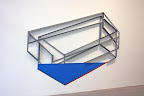
Preamble: So my Two Influences are Jose Pedro Croft and Bridget Riley. I love Croft´s work. Having spent a happy couple of hours in the Library rummaging through books and catalogues I have come to appreciate the direction his work has taken over the last thirty years. It´s his most recent work that I will be examining, his outlines of impossible con-joined forms, created from steel, but presented as two-dimensional. I hate Riley´s work. A few trippy optical illusions left over from the 60s. But such depth. Physical depth, you understand; she isn´t speaking to me. And so, combining these two-dimensional into three-dimensional tricksters with new sketches for my "Abstract Heads" series I will play with the idea of creating a 2D form from a 3D model.
All the snaps I took for this exercise can be seen here.
My two influences are Jose Pedro Croft and Bridget Riley.
From Bridget Riley, I want to take depth perception. I am going to try to create an "Abstract Head" using coloured lines that follow from front to back of a box. This will give physical depth to the piece, but I want the finished piece to "work" in two dimensions. We'll see how it goes in my six hour study.


I bought half a metre of Art Books from a friend of a friend the other day, and in this pile was an old exhibition catalogue of the work of Jose Pedro Croft. It was beautiful sculpture using simple forms and objects, but I realised he must have moved on by now. And he has. So here's some work that I will take as "Influence 1".


.jpg)

In this task I want to explore 2D drawing in a 3D world. I am going to use a box to hold a 3D volume and then re-create an "Abstract Head" using coloured tape. If looked at from a directly frontal position, the work should look like a 2D Abstract Head, but it will clearly be a 3D drawing if you move from side to side.

Normally in a 2D drawing you can create perspective by making the lines thicker in the foreground and thinner in the background. With tape this will not be possible, so it will be interesting to see what this does to the perspective. [Of course, as I realised when I was talking to Jo about my work, this is irrelevant, as the tape will APPEAR to be thinner by virtue of it being further away!]
 2
2 3
3 4
4
I found it very hard to get the perspective right... the angle of each line was difficult to place, especially on lines that I wanted to move from front to back, and diagonally. You can see above how the red line top right has been moved.
This first attempt was also difficult as the box was too small, not only to work with, but with the width of the tape. The second attempt was easier, though still not quite big enough.
 5
5 6
6
However, there is no support at the front of the box, so no line can start from this front plane. Maybe with a piece of perspex I could try this (though I´m not sure how I would get my hands in!) Jo suggested a fish tank; and I could make a perspex box.
I´d be interested to see how it would work with no supports at all - maybe using fishing line to suspend pieces of wood, plastic or metal.
The next stage was to add a couple of planes to the lines.
 7
7 8
8
This is fabulous. The "flat" plane is a twisting series of pieces of tape, though I had to add another layer of the original tape to re-instate the line:
 9
9
Some of the tape in these planes is twisted, and this would need resolving in a solid steel form were I to make one.
So what would Croft do with a corner? Alexandre Melo discusses his work thus. "The second determining characteristic in the author's work is the dynamization of the spatial relationships within each work and between each work, and the movement of the viewer's body and gaze. This is precisely the effect of simply placing in one of the corners of the room, and half-way up the wall, a bowl molded out of synthetic resin, which, when we come close to it, we realize has no bottom. Without yielding to the artifices of staging or spectacle, Croft brings life, instability, and dynamism to a situation that would otherwise be stable and dead." Read more about Jose Pedro Croft.
In order to create the square in a corner that is the trademark of an Abstract Head, I used Pythagoras´ theorem to measure 50cm both ways from the corner of the wall and marked a height of 70cm to create my imaginary "square", and then started to create the form.
 10
10 11
11 12
12
I did put a black frame around this piece, but Jo was disappointed with it so I took it off later to compare:
 13
13 14
14
We also had a discussion about why "Abstract Heads" need to be square. This is really because, when I was creating the first abstract head I certainly couldn´t use a form as "landscape", and "portrait" could be seen as being a whole body. In order to emphasise the "head" part of the portrait I decided to use a square canvas. But why three canvases? Well, this was to take the cubist idea of giving a multitude of viewpoints to create a dynamic whole. It's for this reason that the lines are drawn freehand, quickly and without precision. It is to create a dynamism between the three images.
Once again, the planes make interesting surfaces, and I wonder how these would work in a solid plane, rather than as a series of "planks".
In order to understand my sculptures, I decided to take Richard Serra´s advice: "To draw from my sculpture after its completion is a way of informing myself about the work, trying to bring the piece closer to me, trying to have a look at what I am up to, trying to see it afresh. You only see a work with fresh eyes once; you never see it like that again. To retain that moment, to conclude the work, to distil it into another language, is the essence of my notebook drawings." Richard Serra: Drawings and Etchings from Iceland Matthew Marks, Publisher: Matthew Marks Gallery ISBN: 1880146037 Edition: Hardcover; 1992-01
 15
15 16
16 17
17
I found these to be quite organic, and rather frightening, like zombies with missing flesh. Jo, however, suggested they were like maps or ley lines.
As I had run out of tape, but not time, I decided to do a final piece of exploration using some wooden off cuts that were lying around to create a quick 3D with a deep volume. I didn´t want to create a relief sculpture, but something more dynamic:
 18
18 19
19
 20
20
This last piece was very rushed but it does give some clues as to where I might take the idea into a 3D sculpture.
Overall the 6 hours taught me quite a lot about how I think as an artist. I have lots of ideas, and want to be able to try them all out. I like pottering about in the studio, and very much enjoyed the deadline of the six hours as a means to an end. I spent about an hour in the library the day before, looking at the work of Jose Pedro Croft and Bridget Riley which was certainly very useful in giving me direction for this work. This gave me some extra thinking time overnight which I used to figure out the mathematics of the corner piece; if I had just tried to go straight into it I think I would have failed to create a real square. I´m certainly going to continue investigating the wooden sculpture, which one of my colleagues at the studio likened to a Calder sculpture.
More on Jose Pedro Croft here.
More on Bridget Riley Here.
All the snaps I took for this exercise can be seen here.
My two influences are Jose Pedro Croft and Bridget Riley.
From Bridget Riley, I want to take depth perception. I am going to try to create an "Abstract Head" using coloured lines that follow from front to back of a box. This will give physical depth to the piece, but I want the finished piece to "work" in two dimensions. We'll see how it goes in my six hour study.
I bought half a metre of Art Books from a friend of a friend the other day, and in this pile was an old exhibition catalogue of the work of Jose Pedro Croft. It was beautiful sculpture using simple forms and objects, but I realised he must have moved on by now. And he has. So here's some work that I will take as "Influence 1".
In this task I want to explore 2D drawing in a 3D world. I am going to use a box to hold a 3D volume and then re-create an "Abstract Head" using coloured tape. If looked at from a directly frontal position, the work should look like a 2D Abstract Head, but it will clearly be a 3D drawing if you move from side to side.
Normally in a 2D drawing you can create perspective by making the lines thicker in the foreground and thinner in the background. With tape this will not be possible, so it will be interesting to see what this does to the perspective. [Of course, as I realised when I was talking to Jo about my work, this is irrelevant, as the tape will APPEAR to be thinner by virtue of it being further away!]
234I found it very hard to get the perspective right... the angle of each line was difficult to place, especially on lines that I wanted to move from front to back, and diagonally. You can see above how the red line top right has been moved.
This first attempt was also difficult as the box was too small, not only to work with, but with the width of the tape. The second attempt was easier, though still not quite big enough.
56However, there is no support at the front of the box, so no line can start from this front plane. Maybe with a piece of perspex I could try this (though I´m not sure how I would get my hands in!) Jo suggested a fish tank; and I could make a perspex box.
I´d be interested to see how it would work with no supports at all - maybe using fishing line to suspend pieces of wood, plastic or metal.
The next stage was to add a couple of planes to the lines.
78This is fabulous. The "flat" plane is a twisting series of pieces of tape, though I had to add another layer of the original tape to re-instate the line:
9Some of the tape in these planes is twisted, and this would need resolving in a solid steel form were I to make one.
So what would Croft do with a corner? Alexandre Melo discusses his work thus. "The second determining characteristic in the author's work is the dynamization of the spatial relationships within each work and between each work, and the movement of the viewer's body and gaze. This is precisely the effect of simply placing in one of the corners of the room, and half-way up the wall, a bowl molded out of synthetic resin, which, when we come close to it, we realize has no bottom. Without yielding to the artifices of staging or spectacle, Croft brings life, instability, and dynamism to a situation that would otherwise be stable and dead." Read more about Jose Pedro Croft.
In order to create the square in a corner that is the trademark of an Abstract Head, I used Pythagoras´ theorem to measure 50cm both ways from the corner of the wall and marked a height of 70cm to create my imaginary "square", and then started to create the form.
101112I did put a black frame around this piece, but Jo was disappointed with it so I took it off later to compare:
1314We also had a discussion about why "Abstract Heads" need to be square. This is really because, when I was creating the first abstract head I certainly couldn´t use a form as "landscape", and "portrait" could be seen as being a whole body. In order to emphasise the "head" part of the portrait I decided to use a square canvas. But why three canvases? Well, this was to take the cubist idea of giving a multitude of viewpoints to create a dynamic whole. It's for this reason that the lines are drawn freehand, quickly and without precision. It is to create a dynamism between the three images.
Once again, the planes make interesting surfaces, and I wonder how these would work in a solid plane, rather than as a series of "planks".
In order to understand my sculptures, I decided to take Richard Serra´s advice: "To draw from my sculpture after its completion is a way of informing myself about the work, trying to bring the piece closer to me, trying to have a look at what I am up to, trying to see it afresh. You only see a work with fresh eyes once; you never see it like that again. To retain that moment, to conclude the work, to distil it into another language, is the essence of my notebook drawings." Richard Serra: Drawings and Etchings from Iceland Matthew Marks, Publisher: Matthew Marks Gallery ISBN: 1880146037 Edition: Hardcover; 1992-01
151617I found these to be quite organic, and rather frightening, like zombies with missing flesh. Jo, however, suggested they were like maps or ley lines.
As I had run out of tape, but not time, I decided to do a final piece of exploration using some wooden off cuts that were lying around to create a quick 3D with a deep volume. I didn´t want to create a relief sculpture, but something more dynamic:
181920This last piece was very rushed but it does give some clues as to where I might take the idea into a 3D sculpture.
Overall the 6 hours taught me quite a lot about how I think as an artist. I have lots of ideas, and want to be able to try them all out. I like pottering about in the studio, and very much enjoyed the deadline of the six hours as a means to an end. I spent about an hour in the library the day before, looking at the work of Jose Pedro Croft and Bridget Riley which was certainly very useful in giving me direction for this work. This gave me some extra thinking time overnight which I used to figure out the mathematics of the corner piece; if I had just tried to go straight into it I think I would have failed to create a real square. I´m certainly going to continue investigating the wooden sculpture, which one of my colleagues at the studio likened to a Calder sculpture.
More on Jose Pedro Croft here.
More on Bridget Riley Here.
Subscribe to:
Posts (Atom)